What's really changing in 2025 for engineering teams
AI development assistants are no longer simple code completion tools. Solutions like GitHub Copilot, OpenAI Codex, Claude Code, Cursor, Windsurf, Devin, Replit Agent, JetBrains Junie, Amazon Q Developer, or Tabnine are evolving toward an agentic model: AI understands the context of a repository, inspects tickets, modifies files, runs tests, interacts with pull requests, and works asynchronously on assigned tasks.
The central question is therefore no longer "how can we get AI to write code faster?", but rather: how do we integrate these agents into the software delivery cycle securely, governed, and at scale?
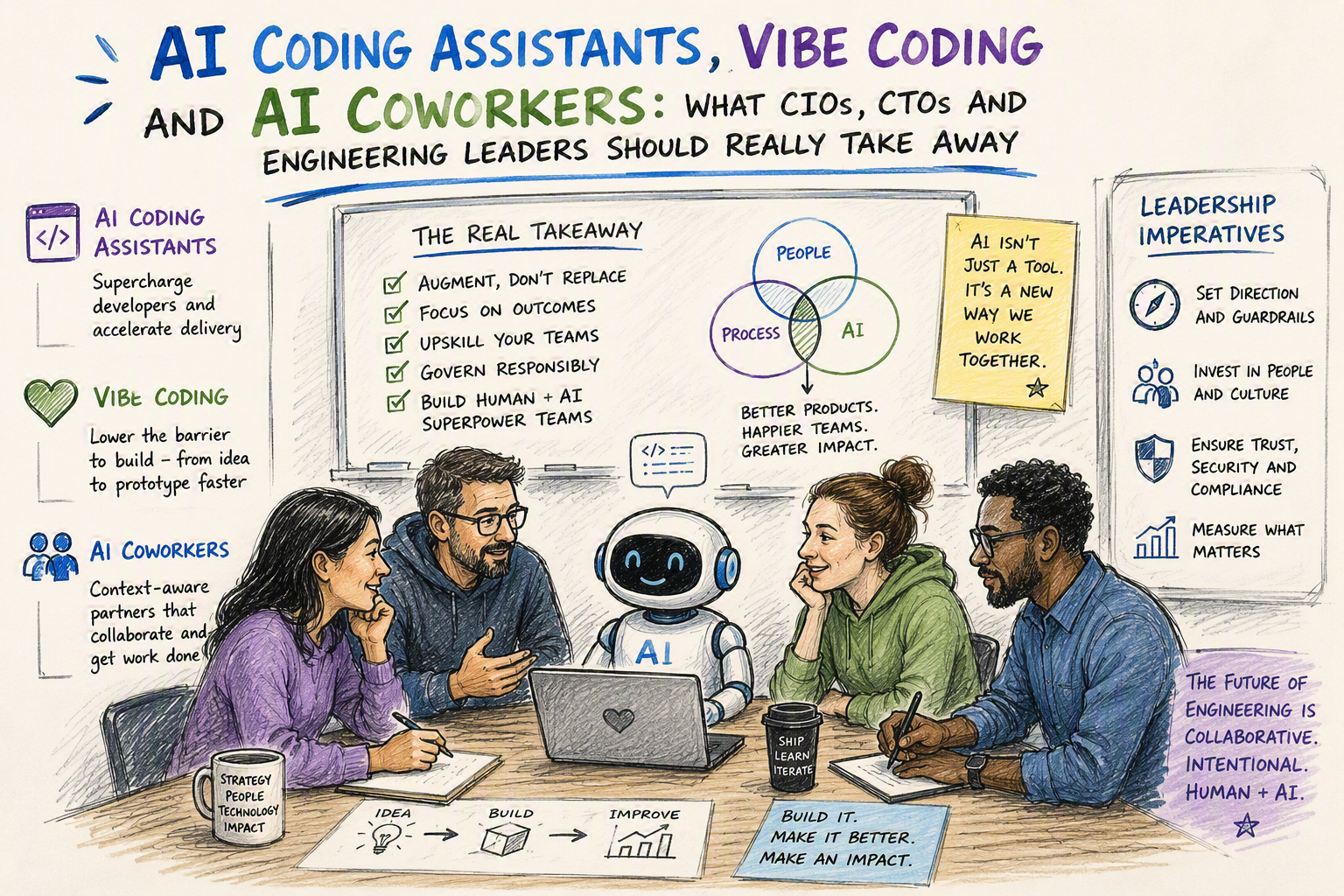
From vibe coding to enterprise operational model
Vibe coding — describing an intention in natural language and getting a functional prototype in a few iterations — represents real acceleration for product teams, startups, consultants, and individual developers.
The prototype is not the product
A prototype quickly generated by AI may work without being secure, maintainable, compliant with architectural standards, or equipped with tests, documentation, and observability. Speed without product governance creates technical debt.
The right approach in the enterprise is not to ban vibe coding, but to position it at the right place in the lifecycle:
- Ideation and rapid prototyping: legitimate and encouraged usage.
- Exploratory internal tooling: acceptable with light guardrails.
- Production, regulated, or critical code: generated code must imperatively go through the same review, security, and qualification processes as human code.
GitHub Copilot as coworker: what it implies for the administrator
With the GitHub Copilot coding agent, teams can now assign tasks directly from issues or prompts. Copilot uses the context of the ticket, works on modifications, creates a branch or pull request, then requests human review at the end.
Delegable task types include notably:
- Fixing minor bugs
- Adding targeted features
- Updating documentation
- Writing or improving tests
- Responding to pull request comments
- Investigating failed checks
- Limited refactoring
The agent acts: it must be governed
If Copilot can modify branches, open pull requests, or respond to feedback, the organization must define precise rules for access, scope, and validation before any scale deployment.
Engineering leaders must define at minimum:
- Which repositories Copilot can view and modify
- Which teams can delegate tasks to it
- What types of work are authorized
- What branch protections apply
- What security scans are mandatory before merge
- How generated modifications are audited
- Who remains accountable before each merge
Privacy goes far beyond model training
Many organizations still evaluate AI assistants with a single question: "Will our code be used to train the model?" This question remains relevant, but it is insufficient.
A modern AI development environment can process, depending on the tool and its configuration:
- Repository structure and commit history
- Issues, pull requests, and workflow metadata
- Terminal commands and execution logs
- Local files, telemetry, and cloud environments
"Not used for training" does not automatically mean "private".
The layers to evaluate are:
- Data transfer and retention
- Repository indexing and context storage
- Tool access, cloud execution, model routing
- Deletion policies and auditability
Privacy thus becomes an architectural decision, not a checkbox in a DPA.
| Codebase profile | Recommended execution model | Control level |
|---|---|---|
| Public repository / prototype | Cloud agent (e.g. Copilot, Codex) | Standard |
| Non-critical internal application | Cloud agent with restricted access policy | Enhanced |
| Client or confidential code | Private endpoint or local model | Strict |
| Regulated environment (finance, health, defense) | Local model / air-gapped / BYOK | Maximum |
Hybrid AI as the foundation of engineering strategy
The future of AI in software development will be neither 100% cloud nor 100% local: it will be hybrid. Tools like Ollama, vLLM, Foundry Local, LM Studio, or Continue make it possible to build flexible AI development environments where model routing depends on context.
The GitHub Copilot CLI illustrates this direction with BYOK support and local models for providers like Ollama, vLLM, and Foundry Local.
A mature routing schema could look like:
1routing_policy:2 sensitive_or_offline_tasks:3 model: local # e.g. Ollama, LM Studio4 complex_reasoning_or_large_refactoring:5 model: cloud # e.g. Codex, Claude Code6 regulated_workloads:7 model: private_endpoint # internally hosted endpoint8 audit_and_policy_enforcement:9 gateway: enterprise_gateway # centralized control layer10 issue_to_pr_workflows:11 tool: github_copilot_coding_agent12 cross_functional_workplace:13 tool: microsoft_365_copilot_coworkThe right model is selected based on the task, code sensitivity, acceptable latency, and cost.
What this concretely changes for the administrator and engineering leader
Adopting AI development agents without a defined operational model quickly generates:
- A fragmented landscape (different tools by team, inconsistent policies)
- Duplicated and uncontrolled costs
- Uncontrolled repository exposure
- Security blind spots and blurred accountability
A mature AI operational model must cover seven dimensions:
Catalog of approved tools
Define a catalog by use case (IDE assistant, terminal agent, asynchronous agent, code review assistant, documentation assistant, test assistant, local workflow). The goal is not to approve everything, but to know what is authorized, for whom, and under what conditions.
Classification of repositories by sensitivity
Categorize your repositories: public, internal, confidential, client code, regulated workload, critical system, IaC, prototype. Each category determines the authorized tools and execution model.
Governance of agents as digital identities
If an agent can act, it requires delimited permissions, a defined repository scope, branch restrictions, approval workflows, audit logs, secret protection, and lifecycle controls (including offboarding).
Integration into SDLC quality gates
Code generated by AI must go through the same controls as human code — and sometimes stricter controls, since generation speed can multiply risks. Apply: peer review, security scanning (SAST/DAST), dependency scanning, secret detection, license verification, test coverage, and traceability of AI contributions in pull requests.
Hybrid model routing
Define routing rules based on task, sensitivity, and regulatory constraint (see YAML example above).
Metrics oriented toward value, not volume
Don't measure the number of generated lines. Measure: cycle time, pull request quality, defect rate, test coverage, incident rate, developer satisfaction, and cost per successful task.
Training in AI supervision
Developers must learn to scope tasks for agents, write precise instructions, review generated code, detect hallucinated APIs, validate architectural choices, and decide when AI should not be used.
Inter-team collaboration essential
Defining the AI operational model must involve CIOs, CTOs, CSOs, platform engineering teams, legal & compliance teams, and engineering managers. This is no longer a topic reserved for developers.
The real maturity question for organizations
AI development assistants are becoming operational components of the software delivery cycle — much like CI/CD pipelines or security scanning tools. The Microsoft 365 Copilot Cowork extends this same paradigm beyond engineering, by enabling delegation of multi-step workflows on Microsoft 365 tools, which confirms that the AI coworker trend is cross-functional across the entire enterprise.
The maturity question that each organization must be able to answer clearly is:
Which development task should run on which model, in which environment, with which permissions, under which governance, and at what cost?
It is on this condition that development AI moves from the experimentation stage to industrial value. To deepen the issues of AI agent governance in the enterprise, the Microsoft Learn documentation on GitHub Copilot for Business and GitHub security guidelines for agents are good starting references.