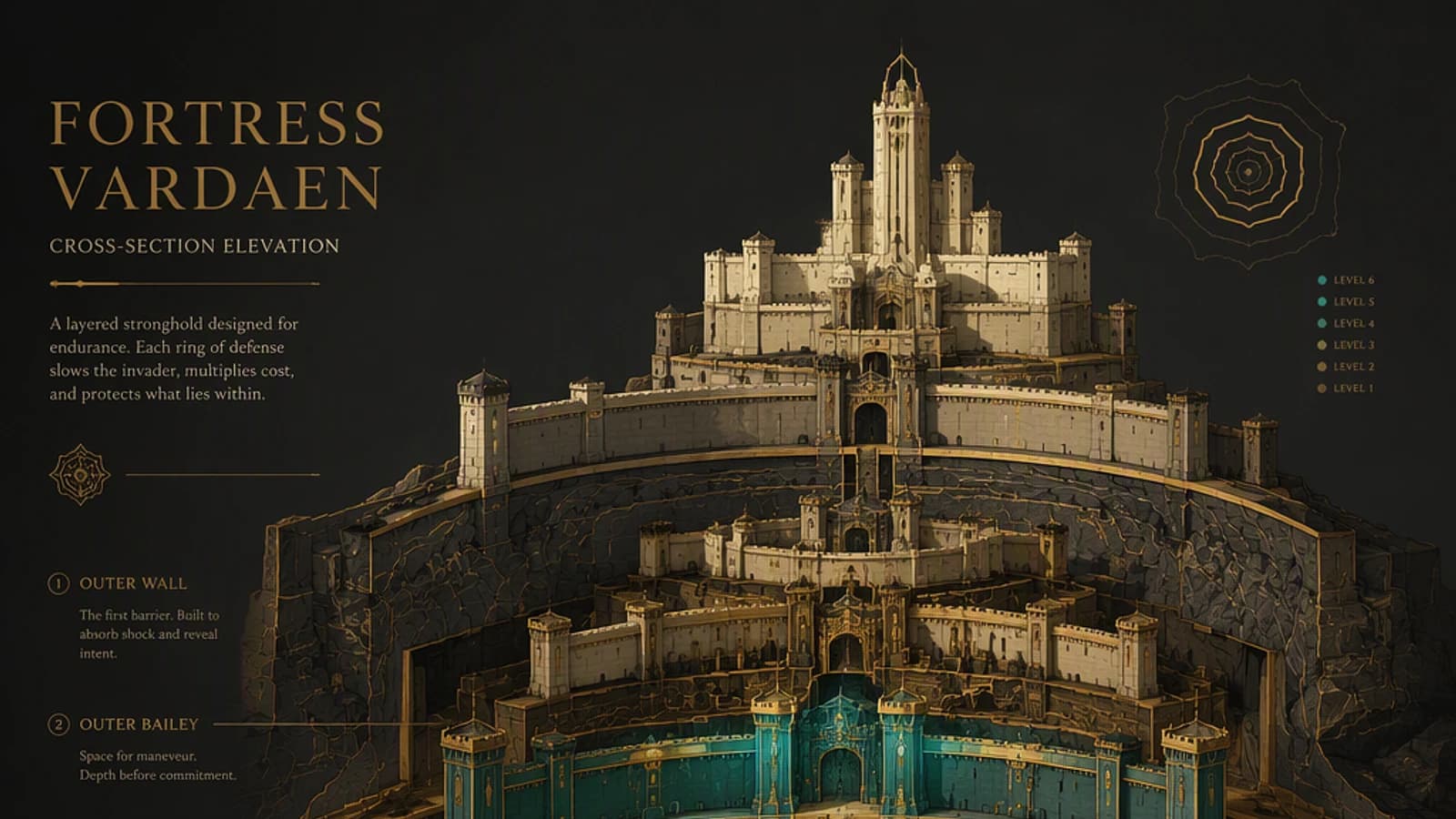
A structured framework for thinking about defense in depth
Cybersecurity is not just about stacking tools. It is built like an architecture, with complementary layers that reinforce each other mutually. A reference framework in 12 pillars offers precisely this perspective: each domain is described according to scenarios to protect and associated design points.
This breakdown is particularly useful for cloud architects and CISOs operating on Microsoft 365 and Azure, two ecosystems where defense in depth relies on the combination of native controls — identity, encryption, monitoring, compliance. Here's how to translate these 12 domains into concrete actions.
Why this framework is useful
Used as an audit grid, this reference framework allows you to quickly identify blind spots in a security strategy: too often, organizations invest heavily in the network or endpoints, while neglecting third-party management or compliance.
Identity and access: the first line of defense
Two pillars structure identity-centric security, today the foundation of any Zero Trust architecture.
Authentication covers user login and access to internal systems. Key design points:
- a robust password policy;
- systematic multi-factor authentication (MFA);
- conditional access policies adapted to the risk level.
In the Microsoft ecosystem, this translates directly to Microsoft Entra ID and its conditional access policies.
Authorization completes the system through role-based access control (RBAC), the principle of least privilege, and regular reviews of permissions. On Azure, this is achieved through Azure RBAC combined with Microsoft Entra Privileged Identity Management (PIM) for temporary elevation of rights.
1# List active privileged role assignments via Microsoft Graph2Get-MgRoleManagementDirectoryRoleAssignment -Filter "roleDefinitionId eq '62e90394-69f5-4237-9190-012177145e10'"Recommended starting point
If only one pillar must be prioritized, it's this one. The majority of recent compromises in Microsoft 365 environments stem from an account with privileges lacking MFA or a Global Administrator role permanently assigned.
Data protection: encryption and confidentiality
Encryption protects sensitive data at rest and in transit. Design points include:
- TLS to secure network communications;
- rigorous management of encryption keys;
- separation of keys and encrypted data.
On Azure, this pillar relies on Azure Key Vault to centralize the management of keys, secrets and certificates, with granular access control through Entra ID. Official documentation: Azure Key Vault Overview.
Identity, authorization and encryption thus form the basic triptych: without it, all other pillars rest on fragile foundations.
Operational resilience: disaster recovery and vulnerabilities
Two pillars assess the organization's ability to absorb a shock.
Disaster Recovery prepares recovery after an attack or data center outage. Design points:
- a formalized and tested recovery plan;
- regular and verified backups;
- multi-region system redundancy.
Vulnerability management relies on regular scans, continuous monitoring and proactive patching. On Azure, this role is played by Microsoft Defender for Cloud, which centralizes vulnerability assessment of cloud and hybrid resources.
An untested recovery plan = a non-existent plan
A disaster recovery plan that has never been executed under real conditions guarantees nothing. Schedule restoration exercises at least once a year, outside production hours.
Compliance, audit and incident response
Audit and compliance cover regulatory requirements — GDPR, HIPAA notably — with exhaustive logging of access and administrative actions. On Microsoft 365, this corresponds to Microsoft Purview capabilities for unified audit and records management.
Emergency responses address DDoS attack and data breach scenarios, with:
- a documented incident response plan;
- an operational security operations center (SOC);
- regular simulation exercises (tabletop exercises).
Microsoft Sentinel plays a central role here as a cloud-native SIEM/SOAR solution, correlating signals from Defender, Entra ID and third-party sources. Documentation: Microsoft Sentinel Overview.
Security of technical surfaces: network, endpoints, APIs, containers
Four pillars target classic attack surfaces.
| Pillar | Scenario to protect | Key design points |
|---|---|---|
| Network security | Internal and external traffic | Firewall, segmentation, intrusion detection, secure DNS |
| Endpoint security | Employee workstations, point of sale | Antivirus, device management (MDM), disk encryption |
| API security | Integrations and exposed services | OAuth 2, rate limiting, input validation, API key management |
| Container security | Microservices, Kubernetes clusters | Trusted base images, container analysis, cluster hardening |
In an Azure environment, these controls are found respectively in Azure Firewall and network security groups (NSG), Microsoft Intune for endpoint management, Azure API Management for API security, and Microsoft Defender for Containers for image analysis and protection of Azure Kubernetes Service (AKS) clusters.
1# Example: analyze a container image before deployment on AKS2az acr task run --registry myRegistry --name security-scanThird-party management: the often overlooked pillar
The twelfth pillar, third-party management (3rd-Party Management), remains frequently underestimated. It covers:
- risk assessment of vendors before integration;
- secure integration of APIs and external data flows;
- continuous monitoring of access granted to partners or service providers.
This pillar is gaining importance with the proliferation of SaaS integrations and applications registered in Microsoft Entra ID. Regular audit of third-party applications with Microsoft Graph permissions (via Entra ID App Governance) helps limit exposure related to the software supply chain.
Frequent blind spot
A third-party application with OAuth consent and extended permissions (Mail.ReadWrite, Files.ReadWrite.All) remains active even after the service provider who integrated it leaves, if no one revokes the consent. Regularly check registered applications and their granted permissions.
Key takeaways
This 12-pillar reference framework provides a balanced audit grid, not limited to technical aspects:
- Identity, authorization and encryption form the foundation: without them, other controls lose their effectiveness.
- Operational resilience (disaster recovery, vulnerability management) must be regularly tested, not just documented.
- Compliance and incident response rely on native tools like Microsoft Purview and Microsoft Sentinel.
- Technical security (network, endpoints, APIs, containers) remains essential but insufficient on its own.
- Third-party management is the pillar most often forgotten in internal audits.
For an organization operating on Microsoft 365 and Azure, each of these domains finds a native equivalent in the platform — from Entra ID to Defender, through Key Vault and Sentinel. The next concrete step is to map, pillar by pillar, the controls already in place and those that are missing, to prioritize security investments on genuinely at-risk areas.