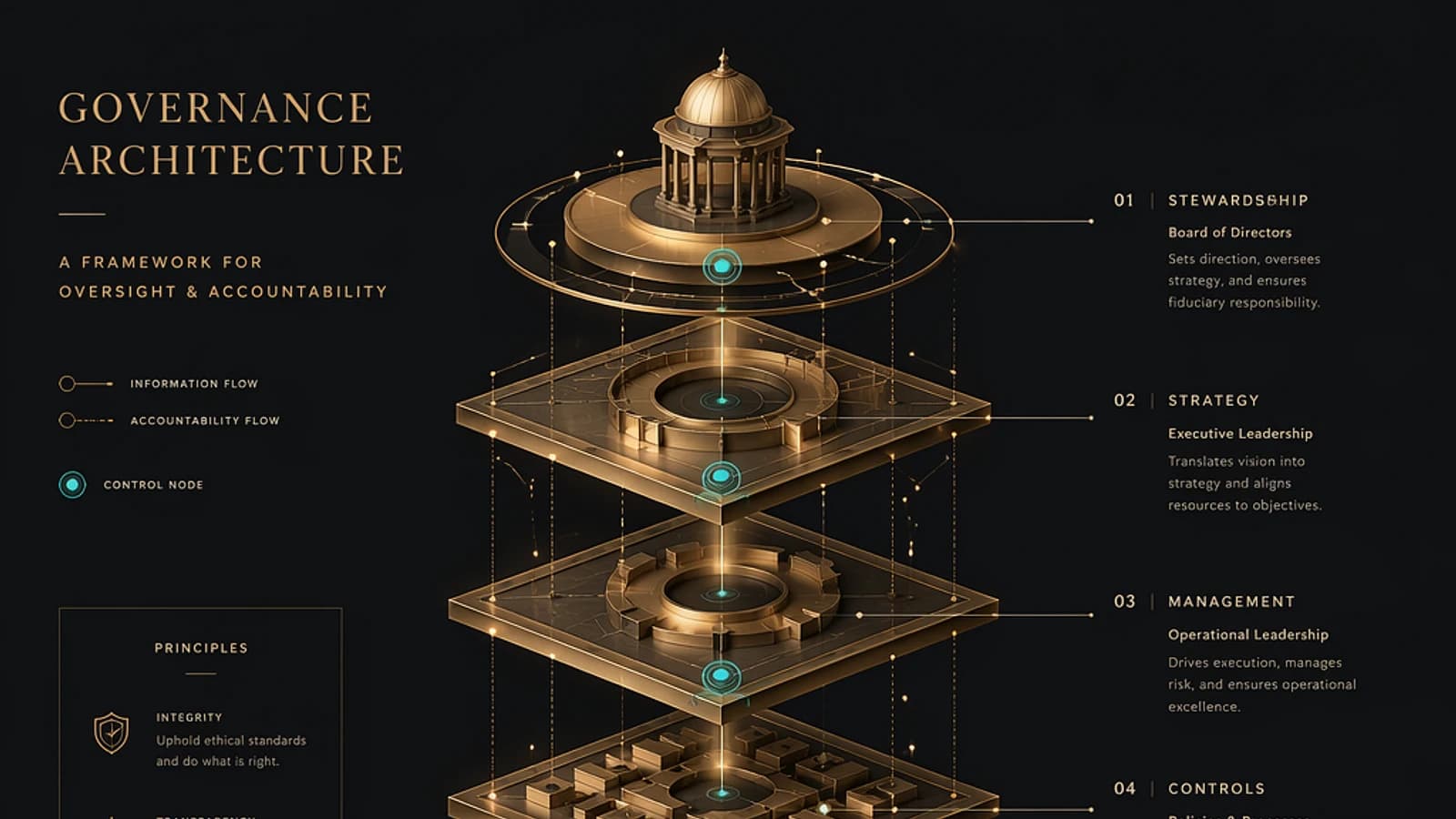
Why AI governance has become a strategic priority
As artificial intelligence projects proliferate within organizations, AI governance has become an essential prerequisite before any industrial-scale deployment. Long overshadowed by the urgency of proof-of-concept demonstrations, it now forms the foundation upon which trust, compliance, and sustainability of deployed systems rest.
Far from being a brake on innovation, a well-designed governance framework makes it possible to secure each deployment, trace algorithmic decisions, and guarantee clear accountability at every level of the organization.
Definition
AI governance refers to the set of policies, processes, roles, and tools put in place to oversee the lifecycle of AI models: from their design to their decommissioning, including their monitoring in production.
From ad hoc experimentation to governed AI: a three-phase trajectory
The evolution of maturity in AI governance follows an observable trajectory in most large organizations:
- 2015 — Ad hoc experimentation: AI initiatives are isolated, without formal oversight. Data science teams operate in silos, without common policies or approval processes.
- 2020 — Internal policy-driven management: basic rules emerge. Validation committees form, and the first usage charters appear.
- 2025 — AI governed at scale: governance is natively integrated into all systems and processes. Each deployment follows a continuous compliance framework.
This maturation reflects a reality that many IT directors face today: after pilot phases, it becomes imperative to structure, trace, and oversee each model in production to meet regulatory requirements — notably the EU AI Act — and maintain stakeholder trust.
Point of caution
Many organizations underestimate the organizational leap between the pilot phase and scaling. Without formalized governance, technical and regulatory debt accumulates rapidly.
The four fundamental pillars of an AI governance system
An operational governance system rests on four complementary layers. Each addresses a distinct aspect of the model lifecycle.
1. Risk Classification
Every AI use case must be categorized according to its potential impact level: low, medium, or high. This classification determines the applicable level of control and explicitly defines what is permitted, restricted, or forbidden.
- Define a criticality grid adapted to the business context
- Document evaluation criteria (sensitive data, automated decisions, impact on individuals)
- Review the classification with each significant model evolution
2. Model Accountability
Each model deployed in production must have a designated owner (model owner), responsible for its lifecycle. This includes:
- A centralized registry referencing each model, its version, its training data, and its scope of use
- A formal procedure for transferring responsibility in case of team changes
- A documented decommissioning process
3. Monitoring and Auditability
Exhaustive logging of model decisions is non-negotiable in a demanding regulatory context. The monitoring system must cover:
- Real-time detection of distribution drift (data drift, concept drift)
- Identification of emerging biases and performance degradations
- Complete traceability of predictions for internal and external audits
4. Human Oversight
The governance framework must explicitly specify the conditions under which human intervention is required, particularly for high-impact decisions. You should:
- Define confidence thresholds below which manual review is triggered
- Establish clear escalation paths for edge cases or failures
- Train operational teams on intervention procedures
Without governance vs. with governance: comparative analysis
| Dimension | Without AI governance | With AI governance |
|---|---|---|
| Visibility | Complete absence of decision traceability | Complete and timestamped audit of each decision |
| Accountability | Models without identified owner | Ownership clearly defined and documented |
| Risk Management | Late detection, often after incident | Proactive anticipation and continuous management |
| Standardization | Inconsistent behaviors across teams | Harmonized processes across the organization |
| Shadow AI | Uncontrolled proliferation of unapproved tools | Validated and centralized AI ecosystem |
| Incidents | No formalized response plan | Prepared runbooks and response strategies |
This contrast concretely illustrates the return on investment of a structured governance approach. The question is no longer whether an organization should adopt such a framework, but how quickly it can implement one.
Overview of AI governance tools on the market
The ecosystem of AI governance solutions has expanded considerably over the past two years. Here are the main platforms to consider depending on the level of intervention:
- Microsoft Purview: governance of data and AI at the organizational level, with cataloging, classification, and traceability capabilities integrated into the Microsoft 365 ecosystem.
- IBM watsonx.governance: bias tracking, drift monitoring, and regulatory compliance at the model level, with explainability dashboards.
- Aporia: real-time guardrails at the inference level, allowing you to block or alert on outputs that do not conform to defined policies.
- Fiddler AI: performance monitoring, explainability, and bias detection at the model level.
- Credo AI: policy as code approach at the portfolio level, allowing you to automate compliance evaluation of models.
The governance pyramid: a three-level architecture
These tools are arranged in a layered architecture:
- Base — AI policies and standards: the non-negotiable starting point. Without a documented reference framework, no tool can deliver results.
- Intermediate level — Risk and compliance: the layer where most initiatives stall, due to lack of appropriate tooling or clear processes.
- Summit — Governance at scale: the cross-functional control layer, often neglected until incidents appear in production.
Implementation tip
Favor an incremental approach: start by formalizing your policies before investing in tools. A monitoring tool applied to undefined processes does not deliver value.
Regulatory frameworks: NIST AI RMF and EU AI Act
Two frameworks now structure the AI governance landscape internationally:
- NIST AI Risk Management Framework (AI RMF): voluntary framework published by the National Institute of Standards and Technology, organized around four functions — Govern, Map, Measure, Manage. Particularly suited to organizations seeking a structured but flexible approach.
- EU AI Act: European regulation that came into force in 2024, which imposes binding obligations depending on the risk level of AI systems. Organizations operating on the European market must comply or face significant penalties.
Choosing one of these frameworks as your foundation makes it possible to conduct a structured gap analysis and prioritize corrective actions.
Practical implementation: actions to launch immediately
Create a registry of AI use cases
Inventory all AI tools and models used in your organization, including formally unapproved uses. A simple spreadsheet can suffice initially:
1{2 "id": "UC-001",3 "name": "Automated credit scoring",4 "owner": "risk.team@company.com",5 "risk_level": "high",6 "status": "approved",7 "last_review_date": "2025-01-15"8}Assign an owner to each model in production
For each identified model, formally designate a model owner responsible for the lifecycle, updates, and continuous compliance. Document this information in your registry.
Draft an acceptable AI use policy
Produce a one-page document defining permitted, restricted, and forbidden uses of AI in your organization. This document must be validated by management and communicated to all employees.
Integrate human review for high-risk outputs
Identify automated decisions with high impact (recruitment, credit, health, safety) and implement a systematic human validation circuit. Define confidence thresholds that trigger manual review.
Audit Shadow AI in circulation
Inventory AI tools used without formal validation (shadow AI). Solutions like Microsoft Purview or Cloud Access Security Broker (CASB) tools allow you to automatically identify these unreferenced uses.
Choose a framework and conduct a gap analysis
Select the NIST AI RMF or EU AI Act as your compliance framework, then conduct a gap analysis to prioritize your actions. Use the following PowerShell script to quickly generate a documented policies inventory report:
1# Example: list documented AI policies in a SharePoint directory2Connect-PnPOnline -Url "https://your-tenant.sharepoint.com/sites/AIGovernance" -Interactive3 4$items = Get-PnPListItem -List "AI Policies" -Fields "Title", "Status", "ReviewDate", "Owner"5 6foreach ($item in $items) {7 [PSCustomObject]@{8 Policy = $item["Title"]9 Status = $item["Status"]10 ReviewDate = $item["ReviewDate"]11 Owner = $item["Owner"]12 }13} | Export-Csv -Path ".\policy_report_ai.csv" -Encoding UTF8 -NoTypeInformation14 15Write-Host "Report generated: policy_report_ai.csv"Critical point
The EU AI Act imposes strict compliance timelines depending on the risk category of AI systems. High-risk systems must be compliant by August 2026. A gap analysis conducted now is essential to avoid penalties that can reach 3% of annual global turnover.
Reference resources
To deepen your AI governance approach, consult the following resources:
- NIST AI Risk Management Framework 1.0 — Comprehensive AI risk management reference framework
- EU AI Act — Official text — European regulation on artificial intelligence
- Microsoft Purview — AI Governance — Official Microsoft documentation
- ISO/IEC 42001:2023 — International standard for AI management systems
- ENISA AI Threat Landscape — Overview of AI-related threats by the European cybersecurity agency
AI governance is not a one-time project but a continuous discipline. Organizations that integrate it as a dedicated organizational capability will be best positioned to leverage AI advances while managing associated risks.