
The transformational impact of Copilot on data security
Microsoft 365 Copilot is revolutionizing information access in enterprise environments by leveraging the power of Microsoft Graph. This artificial intelligence automatically analyzes, synthesizes, and contextualizes data scattered across SharePoint, OneDrive, Teams, and Exchange, relying on permissions already granted to users.
However, this capability reveals a critical challenge: Copilot generates no new access authorizations, but instantly transforms all content that a user already has access to into actionable information. In organizations where data governance has gaps, this reality can lead to unintentional exposure of confidential information.
Warning
Copilot acts as an amplifier of existing permissions. Any data accessible to a user becomes potentially exploitable by AI, even if that data was never accessed before.
Identifying the root causes of oversharing
Data oversharing in Microsoft 365 environments rarely results from deliberate malicious actions. Rather, it is the accumulation of sharing decisions made over time without systematic review.
Factors contributing to oversharing include:
- Default sharing settings that are too permissive at the site and library level
- Orphaned SharePoint sites without an active owner to supervise access
- Obsolete inherited permissions never audited or updated
- Sensitive content stored in open collaborative spaces
- Lack of data classification according to sensitivity level
Before Copilot's arrival, this data remained fragmented and difficult to exploit. AI fundamentally changes the game by enabling instant aggregation, summarization, and reformulation of this information, creating new exposure vectors.
Three-phase progressive governance methodology
Microsoft advocates a structured approach to deploying Copilot while managing security risks. This methodology breaks down into three distinct and complementary phases.
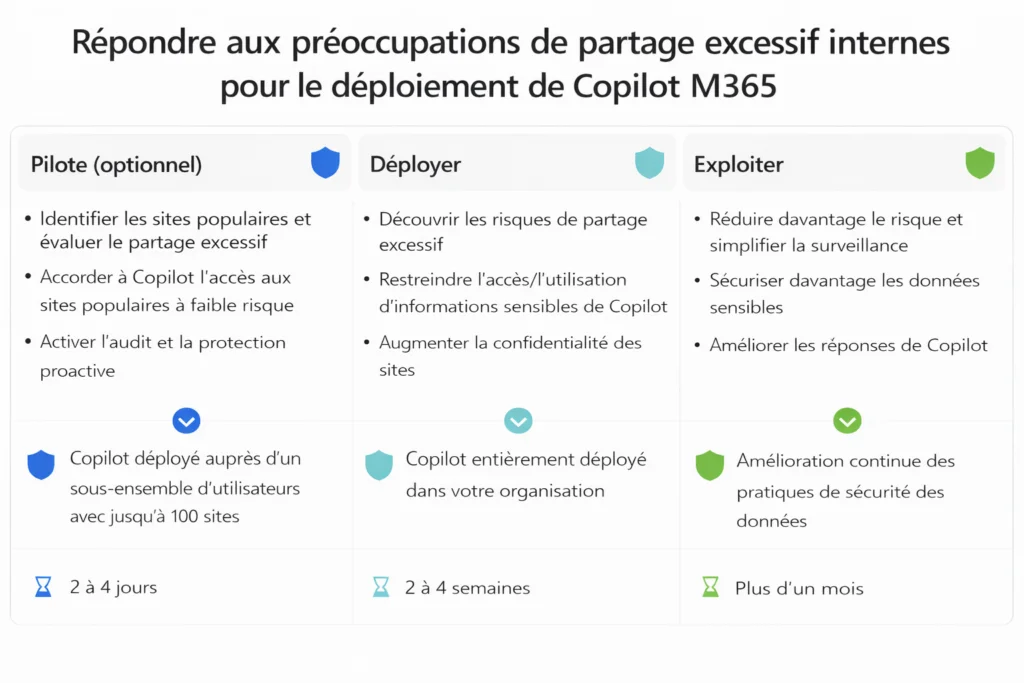
Phase 1: Controlled piloting
The pilot phase is the foundation of any secure Copilot deployment. It consists of enabling AI for a restricted number of users within a carefully defined data scope.
Pilot group selection
Identify 10 to 50 representative users across different departments to test Copilot in real-world conditions.
Scope definition
Limit Copilot's access to previously audited and secured SharePoint sites and data.
Intensive monitoring
Observe Copilot's behaviors and identify early cases of oversharing or unintentional exposure.
Control evaluation
Test the effectiveness of existing security policies against AI-generated queries.
This phase frequently reveals excessive access to resources wrongly considered sufficiently protected, allowing security strategy adjustments before wider deployment.
Phase 2: Secure organization-wide deployment
The deployment phase aims to extend Copilot usage to the entire organization while simultaneously strengthening data governance.
Strategic actions in this phase include:
- Reviewing default sharing settings for all Microsoft 365 services
- Systematic deployment of sensitivity labels across all content
- Proactive access restrictions to content classified as critical or confidential
- User training on sharing best practices in a generative AI context
Tip
Privilege a "Zero Trust" approach: each access must be justified and regularly re-evaluated, particularly in an environment where AI can exploit all granted permissions.
Phase 3: Continuous and adaptive governance
Copilot governance cannot be considered a one-time project. It requires permanent monitoring and adjustments, as data and permissions constantly evolve in dynamic environments.
This operational phase enables:
- Proactive monitoring of data exposure over time
- Automated detection of new oversharing cases
- Automated remediation of non-compliant configurations
- Regular reporting to leadership teams on governance status
Without this continuous monitoring, oversharing inevitably reappears, compromising the benefits of previous phases.
Technology arsenal for managing oversharing
Microsoft Purview: the pillar of data governance
Microsoft Purview is the central tool for effectively governing Copilot. Its capabilities include:
- Automatic discovery of sensitive data across all Microsoft 365 services
- Continuous assessment of exposure risks based on permissions and content
- Application of DLP (Data Loss Prevention) policies adapted to generative AI scenarios
- Granular control of content usage by Copilot via sensitivity labels
| Feature | Without Purview | With Purview |
|---|---|---|
| Sensitive data identification | Manual and incomplete | Automatic and comprehensive |
| Copilot control | Limited to permissions | Granular by sensitivity label |
| Access audit | Reactive | Proactive with alerts |
| Remediation | Manual | Automated per policy |
Sensitivity labels ensure that protections remain applied even when files are moved, copied, or shared, creating a persistent security layer.
SharePoint Advanced Management: controlling the primary source of oversharing
SharePoint is often the primary source of oversharing in Microsoft 365 environments. Advanced management capabilities offer:
- In-depth analysis of permission status at all levels of the hierarchy
- Automatic identification of inactive sites or those without an active owner
- Programmatic reduction of content exposure based on predefined criteria
- Automated lifecycle management of sites and their content
These controls prove essential for limiting the attack surface accessible to Copilot while maintaining team productivity.
Operational framework for IT teams
Effective reduction of oversharing relies on implementing reproducible and measurable processes.
Technical best practices
Periodic permission audit
Schedule quarterly reviews of access at the site, library, and critical document levels.
Label standardization
Deploy a consistent taxonomy of sensitivity labels aligned with your organization's data classification.
Adaptive DLP policies
Configure data loss prevention rules specifically designed for Copilot interactions.
Remediation automation
Implement automatic workflows to correct detected non-compliant configurations.
Key Performance Indicators (KPIs)
To measure governance effectiveness, monitor:
- Percentage of content labeled with appropriate sensitivity labels
- Number of SharePoint sites without an active owner (target: 0%)
- Average detection time for new oversharing cases
- Automatic correction rate of non-compliant configurations
Good to know
A mature Copilot governance should allow detection and correction of 80% of oversharing cases automatically, significantly reducing IT team operational burden.
Organizational dimension of governance
Technology alone does not guarantee effective Copilot governance. A holistic approach requires:
Organizational processes
- Clear definition of roles and responsibilities in data management
- Accountability of content owners with associated performance metrics
- Continuous user training on excessive sharing risks in an AI context
- Committee-based governance including IT, security, legal, and business units
Awareness and training
Users must understand that in a generative AI environment, each permission granted can have amplified consequences. Copilot can reveal patterns and connections in data that were not immediately apparent during initial sharing.
Important
User training must emphasize that Copilot can exploit data shared months or years ago, creating unexpected exposures if permissions have not been regularly reviewed.
Toward mature and sustainable governance
Microsoft 365 Copilot acts simultaneously as a productivity accelerator and a revealer of organizational maturity in data governance. Oversharing existed before AI's advent, but Copilot makes it immediately visible and exploitable at an unprecedented scale.
By structuring governance around methodical piloting, secure deployment, and continuous operation, organizations can significantly reduce risks while maximizing the value delivered by generative AI.
Robust governance is not an obstacle to technological innovation. It represents the essential prerequisite for calm and sustainable adoption of Microsoft 365 Copilot in the modern enterprise.