Why Governance Conditions AI Agent Reliability
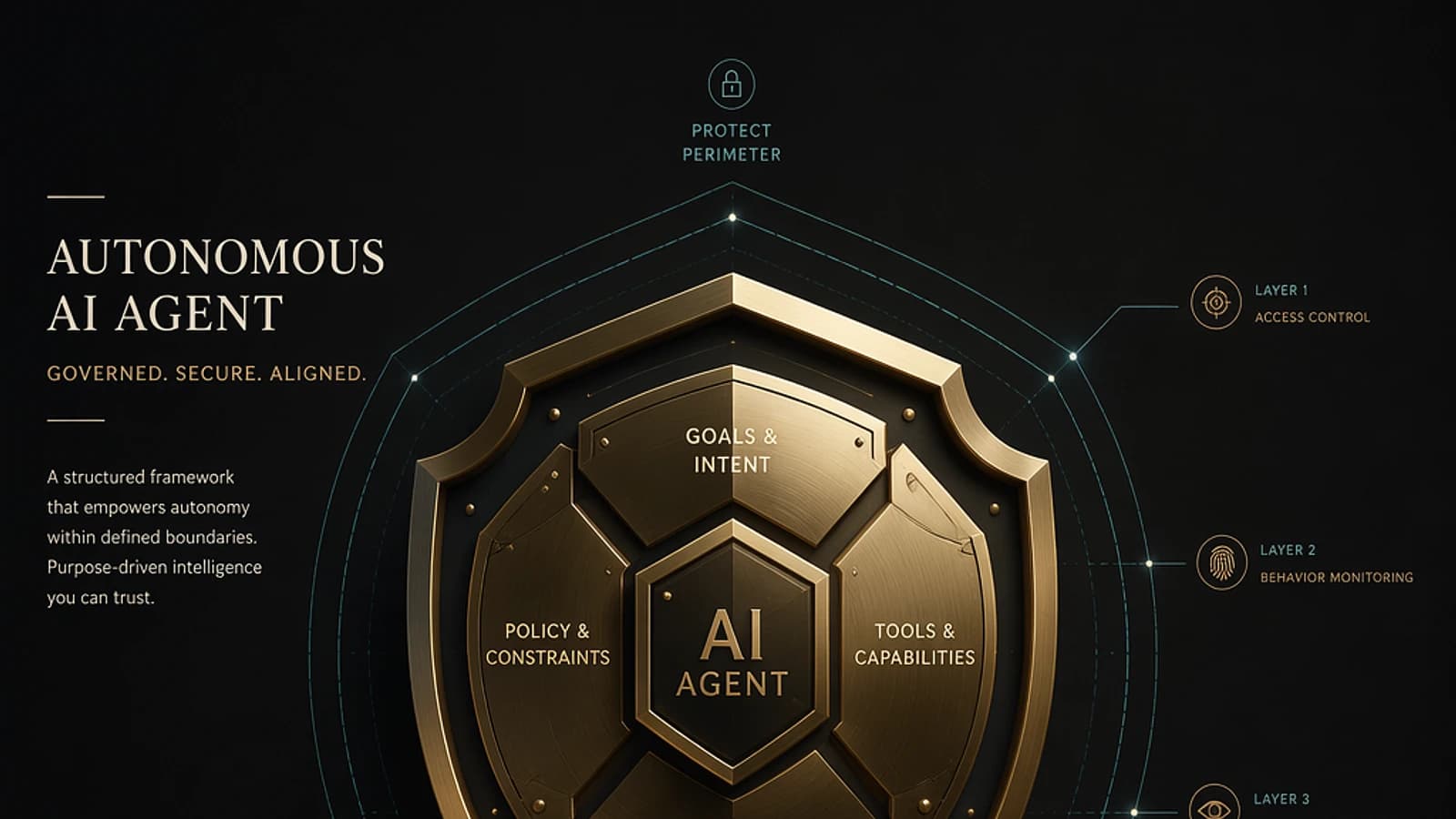
Deploying AI agents in an enterprise environment goes beyond selecting a high-performing language model. The reliability, auditability, and compliance of an agent depend primarily on the governance architecture that frames it — both upstream, at the level of ingested data, and downstream, at the level of produced decisions.
In a constantly evolving regulatory context — EU AI Act, data sovereignty requirements, internal compliance policies — organizations that industrialize AI without a structured framework expose themselves to significant risks: systemic bias, sensitive information leaks, opaque decisions, and audit impossibility. The answer to these risks lies in what architects call the AI governance stack.
Regulatory Context
The EU AI Act, which entered progressive implementation in 2024, imposes explicit traceability, explainability, and human supervision requirements on organizations deploying high-risk AI systems. A structured governance stack constitutes the technical foundation for meeting these obligations. Reference: EU AI Act — EUR-Lex
The Two Fundamental Pillars of AI Governance
Governance architecture is built around two complementary pillars, each targeting a distinct phase of the agent's processing cycle.
Pillar 1 — Data Governance: Controlling Inputs
Data governance constitutes the first barrier. It ensures that information injected into the agent's pipeline is accurate, secure, traceable, and compliant with internal policies. This pillar covers four operational dimensions:
- Quality and accuracy: validation of data sources, detection of anomalies and missing values before ingestion
- Access security: identity control, permission management, and encryption of data in transit and at rest
- Traceability and lineage (data lineage): tracking the origin, transformations, and uses of each dataset
- Policy compliance: application of internal standards (classification, retention, location) and regulatory requirements (GDPR, sector-specific)
Concretely, this pillar orchestrates a progressive path: from raw data to validated data, then accessible, then certified. Without this level of maturity, any AI agent, however sophisticated, risks producing results based on incorrect or unauthorized data.
Pillar 2 — AI Governance: Controlling Outputs
The second pillar targets the results produced by the agent. AI governance ensures that each decision or recommendation is explainable, auditable, and aligned with organizational values. Four axes structure this pillar:
- Explainability and transparency: justification of model decisions, accessibility of reasoning for business teams
- Fairness and safety: detection and mitigation of bias, filtering of inappropriate or dangerous content
- Accountability and auditability: timestamped audit logs, traceability of actions executed by the agent
- Alignment with internal policies: enforcement mechanisms, rejection, or rollback in case of rule violations
Beware of Opaque Decisions
An AI agent that produces recommendations without exploitable justification constitutes an operational and legal risk. The absence of explainability prevents any reasoned challenge of an automated decision, which can engage the organization's liability towards its clients or partners.
Shared Cross-Cutting Concerns
Between these two pillars lie issues that cannot be confined to one or the other scope:
- Data bias: present at the source, they propagate to outputs if no intermediate control is implemented
- Privacy: management of personal data (PII) at each step of the pipeline
- Lineage and overall auditability: ability to trace the complete journey of data, from its source to the final decision
- Risk management: continuous evaluation of organizational exposure related to agent behaviors
Layered Architecture of the AI Governance Stack
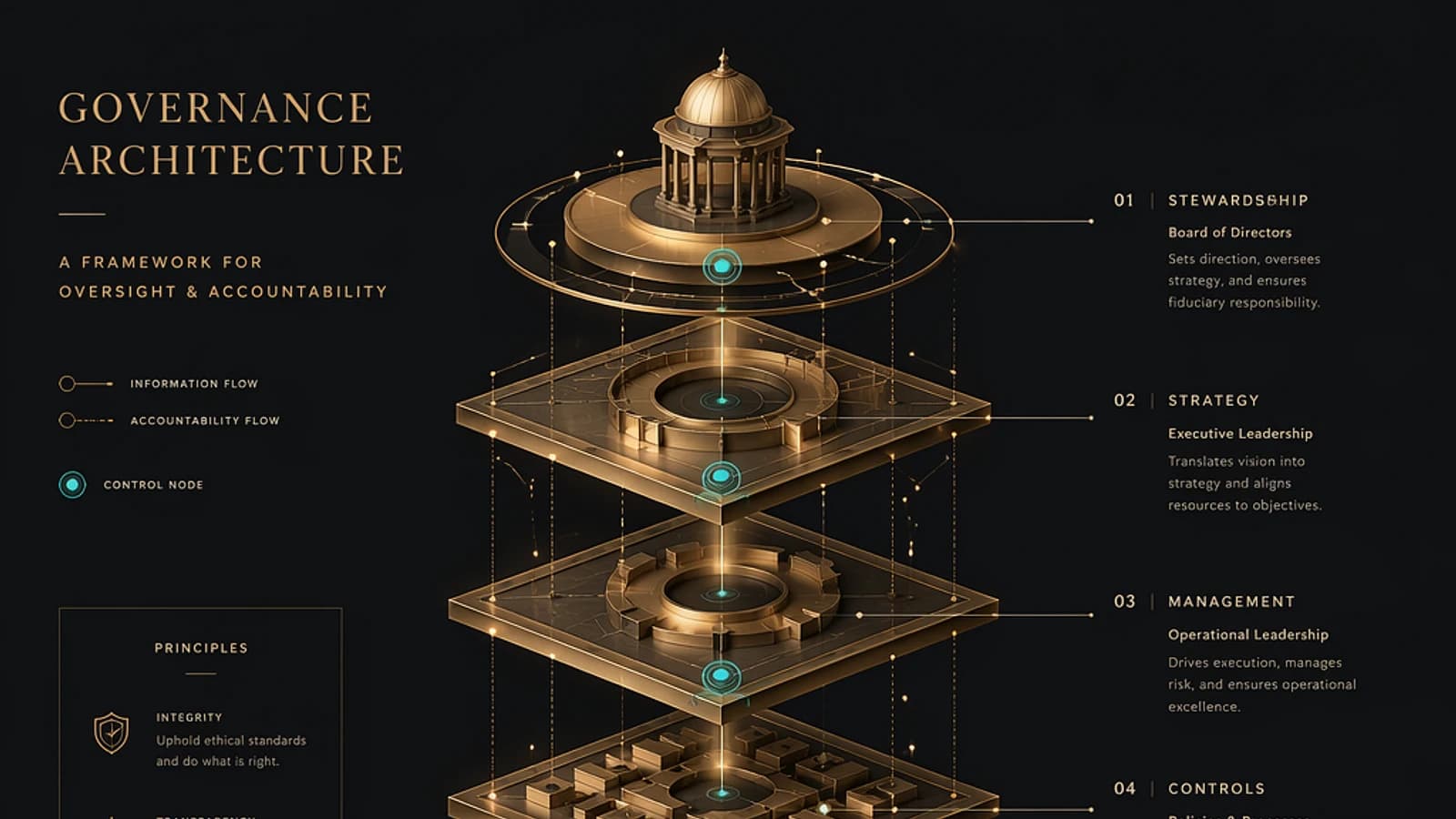
Beyond the two pillars, the governance stack decomposes into five superimposed technical layers, framing the data flow from input to output.
| Layer | Primary Role | Example Components |
|---|---|---|
| Policies and Standards | Define rules, regulatory requirements, and risk appetite | Policy engine, business rules, compliance frameworks |
| Runtime Governance | Real-time application of rules, escalations, and audits | Runtime policy enforcement, audit logs, alerts |
| AI Agent Governance | Model guardrails, fairness, explainability, safety | Content filters, fairness checks, XAI modules |
| Data Governance | Quality, lineage, classification, and access control | Data catalog, lineage tools, RBAC, DLP |
| Infrastructure and Security | Identity, network, encryption, secrets, compliance | Azure AD, Key Vault, VNet, TLS, SIEM |
Input Flow: From Raw Source to Certified Data
The input side of the stack mobilizes the following components, in sequential order:
- Data sources (relational databases, APIs, documents, real-time streams)
- Ingestion and integration (ETL/ELT, connectors, streaming)
- Quality controls (schema validation, completeness scoring)
- Metadata lineage (cataloging, automatic tagging)
- Access and permission management (RBAC, ABAC, Zero Trust)
- Application of policies and standards
Output Flow: From Raw Response to Audited Decision
The output side produces and exposes the following elements:
- Model response accompanied by explanations and justifications
- Confidence scores associated with each recommendation
- Policy and security controls applied post-hoc
- Rejection or rollback mechanisms in case of detected violation
- Timestamped audit logs and compliance reports
- Feedback loops for continuous improvement of the model and rules
Implementation Tip
In the Microsoft Azure ecosystem, several native services can cover these layers: Azure Purview for data lineage and classification, Azure Policy for runtime rule enforcement, Azure Key Vault for secrets management, and Microsoft Sentinel for real-time monitoring and auditing. Azure Purview Documentation
The 5 Essential Governance Controls for Any Production AI Agent
To make these layers operational, five concrete controls must be integrated into any production AI agent implementation.
Trusted Data Pipelines
Establish clear and documented lineage for each data source feeding the agent. This involves:
- Defining a data owner for each dataset
- Managing the complete lifecycle, from ingestion to archival
- Implementing data contracts between producers and consumers
1# Example of simplified data contract2data_contract:3 name: "customer_interactions_v2"4 owner: "data-team@contoso.com"5 classification: "Confidential"6 retention_days: 3657 quality_checks:8 - completeness: 0.989 - freshness_hours: 2410 consumers:11 - agent: "support-agent-prod"12 access_level: "read"13 approved_by: "security@contoso.com"Least Privilege Access Controls
Apply the principle of least privilege to each agent component. The agent should only access resources strictly necessary to accomplish its task, aligned with business needs and regulatory requirements.
In a Microsoft Entra ID context, this translates to:
1# Assign limited role to agent managed identity2$agentPrincipalId = (Get-AzUserAssignedIdentity -ResourceGroupName "rg-agents" -Name "agent-support-identity").PrincipalId3 4New-AzRoleAssignment `5 -ObjectId $agentPrincipalId `6 -RoleDefinitionName "Storage Blob Data Reader" `7 -Scope "/subscriptions/<sub-id>/resourceGroups/rg-data/providers/Microsoft.Storage/storageAccounts/sadatastore"Model Guardrails
Integrate guardrails at each step of the agent's pipeline: input filtering, output control, and supervision of intermediate decisions. These guardrails cover:
- Content filtering (blocking out-of-scope or malicious requests)
- Detection and mitigation of bias in generated responses
- Confidence thresholds below which decisions are suspended
Azure AI Content Safety and Azure OpenAI policies allow native configuration of these filters. Azure AI Content Safety Documentation
Human-in-the-Loop Escalation
Maintaining a human in the loop is non-negotiable for high-impact actions. Explicitly define escalation trigger criteria:
- Model confidence score below a defined threshold (e.g., < 0.75)
- Irreversible actions (data deletion, financial transactions, configuration modifications)
- Detection of sensitive or exceptional context not covered by existing rules
1{2 "escalation_policy": {3 "confidence_threshold": 0.75,4 "irreversible_actions": ["delete", "transfer", "publish"],5 "sensitive_contexts": ["legal", "hr", "financial_over_10k"],6 "escalation_target": "supervisor-queue@contoso.com",7 "sla_minutes": 308 }9}Continuous Real-Time Monitoring
Implement active monitoring covering both input integrity and output behavior. Key indicators to monitor include:
- Data drift: detection of distribution changes in input data
- Hallucination rate: frequency of non-factual or non-grounded responses
- Policy violation rate: number of outputs blocked or rejected by guardrails
- Audit trail latency: delay between an agent action and its logging
In the Azure ecosystem, Azure Monitor, Application Insights, and Microsoft Sentinel provide the necessary primitives for this monitoring. Azure Monitor Documentation
Critical Point: Absence of Monitoring
An AI agent deployed without continuous monitoring in production is an open operational risk. A model's behaviors can drift over time (data drift, model drift) without teams being alerted. Monitoring is not a post-deployment option: it must be designed from the architecture phase.
AI Governance in the Microsoft 365 and Azure Ecosystem
For IT teams working in the Microsoft 365 and Azure ecosystem, several native services enable concrete implementation of this governance stack:
- Microsoft Purview: data governance, classification, lineage, and compliance policies — Documentation
- Azure AI Foundry (formerly Azure AI Studio): development and deployment environment for agents with integrated evaluations — Documentation
- Microsoft Entra ID: identity management and access control for AI components
- Azure Policy: automated enforcement of compliance rules on Azure resources hosting agents
- Microsoft Sentinel: cloud-native SIEM for monitoring and correlating audit events related to agents
- Copilot Studio: agent creation platform with integrated governance controls for Microsoft 365 scenarios — Documentation
Conclusion: Agent Reliability is Built, Not Improvised
The raw performance of a language model is insufficient to guarantee the reliability of an AI agent in production. It is the solidity of the governance stack surrounding this model — quality of input data, output controls, continuous monitoring, and human escalation — that determines the trust an organization can place in it.
By articulating data governance and AI governance around five clearly defined layers and five concrete operational controls, IT teams have an actionable methodological framework for deploying agents that are both powerful and responsible — a requirement that is now unavoidable in any enterprise AI project.