Four concepts, one family
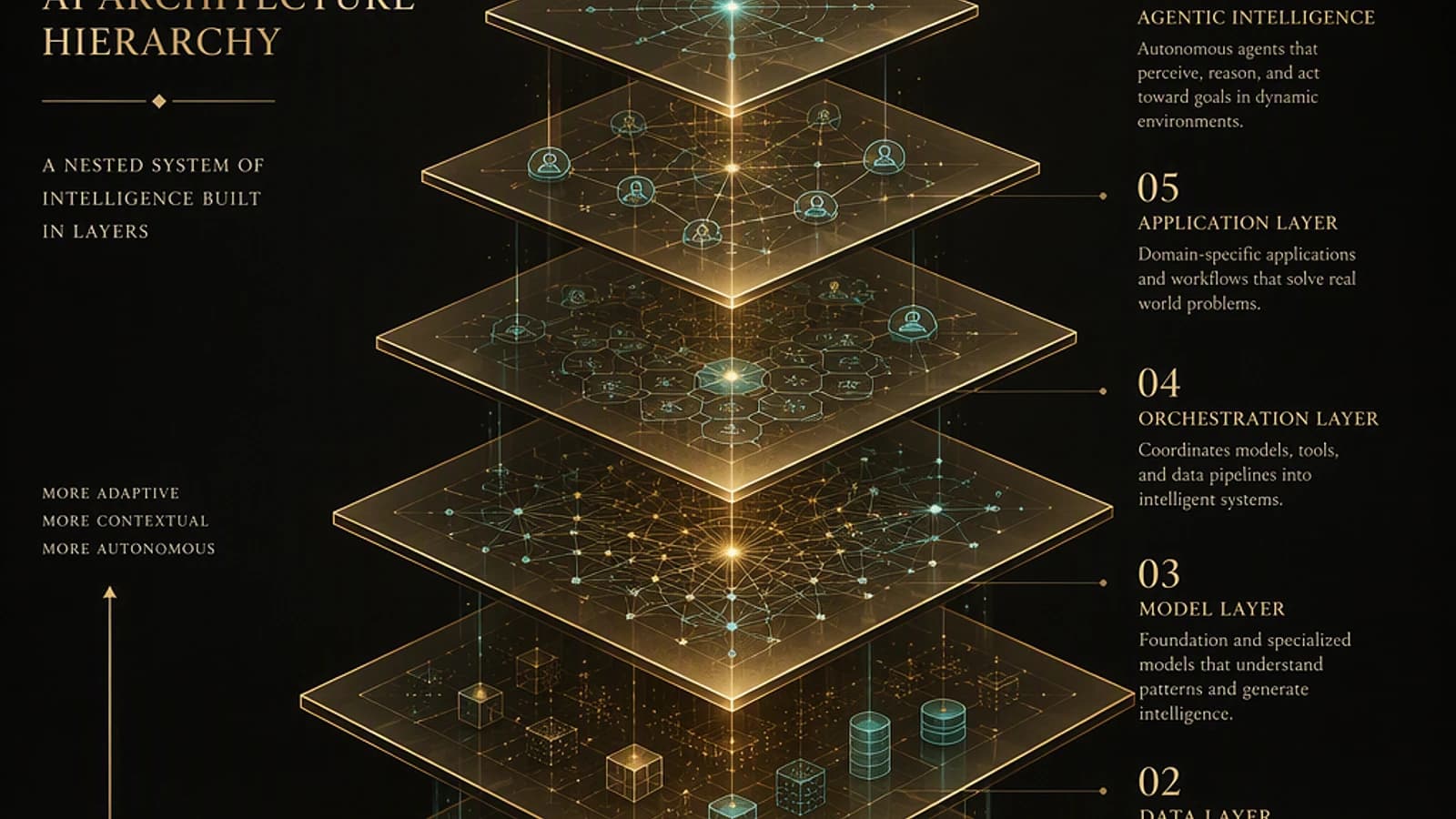
Artificial intelligence, machine learning, deep learning, and generative AI are regularly used interchangeably. They are not. Each designates a distinct level of sophistication, and each level builds on the previous one. The metaphor of a staircase is particularly apt here: each step is both a specialization and an extension of the step below.
Artificial intelligence: the foundation
Artificial intelligence (AI) refers to a machine's ability to perform tasks usually associated with human intelligence: visual recognition, language understanding, decision-making, planning.
AI does not necessarily imply learning. The first AI systems were entirely based on rules coded manually. To detect the letter "L", an engineer would explicitly write: look for a vertical line, look for a shorter horizontal line, verify that they meet at the bottom left.
This approach has an obvious limitation: humans write the letter "L" in hundreds of different ways. Rule-based systems collapse when faced with the variability of the real world. Designing rules to drive a vehicle in real-world conditions is simply impossible at this scale.
Limitations of rule-based systems
A manually coded expert system cannot generalize. It recognizes only what its rules explicitly anticipate. Any unforeseen variation produces an error or incorrect result.
Machine learning: learning from data
Machine learning (ML) changes the paradigm: instead of programming rules, you provide examples. Thousands of images of the letter "L", each labeled, are submitted to the model during a training phase. The model extracts itself the statistical patterns that will allow it to generalize.
ML remains AI — it is a sub-category of it — but the machine learns instead of obeying fixed instructions. The covered use cases are broad:
- Bank fraud detection
- Content recommendation
- Hardware failure prediction
- Support ticket classification
The quality and volume of training data directly determine the quality of the model. A model trained on biased data will produce biased predictions.
Deep learning: layered neural networks
Deep learning is a sub-category of machine learning. Its specificity: the use of artificial neural networks organized in multiple layers (hence the qualifier "deep").
The typical architecture includes:
- An input layer that receives raw data (pixels, sounds, tokens)
- Hidden layers in variable numbers, each building increasingly abstract representations
- An output layer that produces the final result
For handwriting recognition, the first layers detect contours, intermediate layers assemble these contours into shapes, and the last layers identify high-level concepts like letters or words. Each layer builds on the representation constructed by the previous layer.
Biological inspiration, not replication
Artificial neural networks are inspired by the organization of the human brain — neurons connected in layers — without being a functional copy of it. The analogy is pedagogical, not literal.
It is deep learning that enabled major advances in computer vision, speech recognition, and natural language processing (NLP) over the past decade.
Generative AI: creating rather than classifying
Generative AI is today the most visible form of AI in professional environments. It relies primarily on deep learning architectures, but with a radically different objective: generate new content rather than simply recognize or classify.
Where a standard model identifies the letter "L", a generative model can draw a new one, in any style. Where a classifier detects an object in an image, a generative model creates an image from scratch.
The underlying mechanism relies on a probability model built from a massive training corpus. The model learns the statistical relationships between elements of this corpus, then generates new elements consistent with these relationships.
Possible outputs cover:
- Text: writing, summarization, translation, code
- Images: generation from textual descriptions
- Audio: speech synthesis, music
- Code: autocompletion, script generation, code review
| Type | Input | Output | Concrete example |
|---|---|---|---|
| AI (rules) | Manually coded rules | Binary or classified result | Expert diagnostic system |
| Machine Learning | Labeled data | Prediction or classification | Spam filter |
| Deep Learning | Large raw data volumes | Complex representations | Facial recognition |
| Generative AI | Massive unstructured corpus | New content (text, image, code) | Microsoft Copilot, DALL·E |
Large Language Models, engine of the public explosion
Large Language Models (LLM) are a specific category of generative AI trained primarily on text. They form the technical foundation of products like Microsoft Copilot, ChatGPT, or GitHub Copilot.
Their massive adoption in Microsoft 365 professional environments is explained by their ability to:
- Understand instructions in natural language
- Generate contextually coherent responses
- Adapt to business domains via fine-tuning or Retrieval-Augmented Generation (RAG)
For IT administrators, this translates concretely into agents capable of automating support tasks, analyzing logs, or drafting security policies from templates.
Entry point for IT teams
If your organization already uses Microsoft 365 Copilot or Azure OpenAI Service, you are interacting with LLMs. Understanding their architecture helps set proper expectations: an LLM predicts the most probable next token — it does not "understand" in the human sense.
Key points to remember
Here is the hierarchy to memorize:
- Artificial Intelligence: any machine executing tasks related to human intelligence, with or without learning.
- Machine Learning: subset of AI where the machine learns patterns from labeled data, without coded rules.
- Deep Learning: subset of ML using multi-layer neural networks to learn increasingly abstract representations.
- Generative AI: subset of deep learning capable of producing new content — text, image, audio, code — through probabilistic prediction.
Each level integrates the previous one and extends it. Mastering this hierarchy allows you to properly evaluate vendor promises, choose the right technology for a given use case, and frame discussions with business teams.