AI is not monolithic: why think in layers
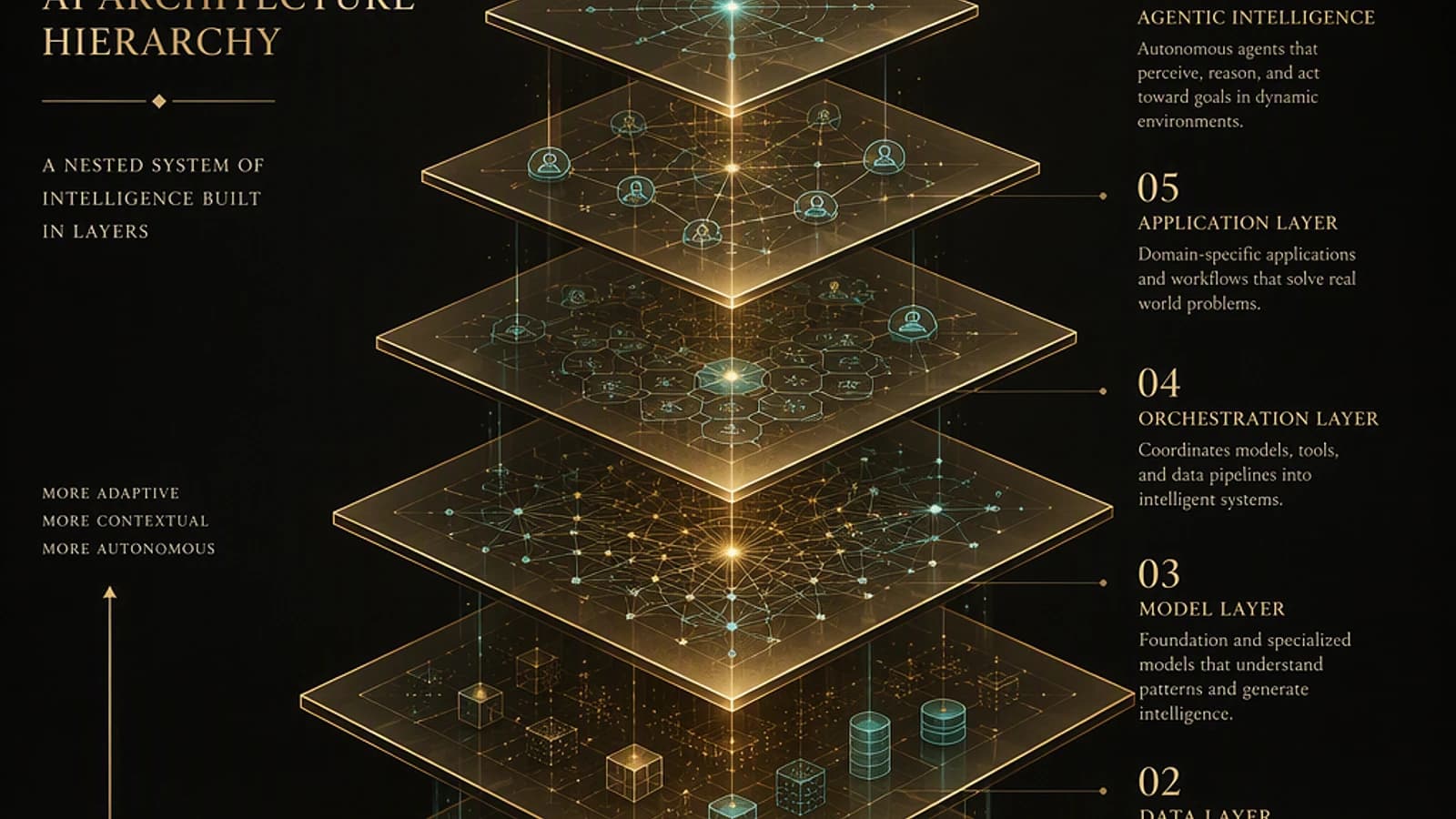
Artificial intelligence is often presented as a uniform block. In reality, it constitutes a cumulative edifice of six distinct strata, each inheriting the capabilities of the previous one. For Microsoft 365 and Azure solution architects, mastering this structure enables you to select the right level of abstraction based on business needs — without over-engineering or underestimating available capabilities.
This article describes each layer operationally, indicating key technologies, limitations, and links to the Microsoft ecosystem.
Layer 1 — Classical AI: explicit rules and expert systems
The foundation of the stack rests on classical AI, also called symbolic AI. It encompasses:
- Expert systems based on manually coded business rules.
- Knowledge representation via ontologies and semantic graphs.
- Formal logic and deductive reasoning.
These approaches dominated the 1970s to 1990s. They remain relevant for domains with stable, auditable rules — regulatory compliance, ticket routing, form validation. Their main limitation: they don't generalize. An unforeseen rule causes silent failure or an unhandled exception.
Current use case
Business rule engines integrated into Power Automate or Azure Logic Apps still fall within this classical AI logic. They coexist with higher layers in hybrid architectures.
Layer 2 — Machine Learning: learning from data
Machine Learning introduces a fundamental paradigm shift: instead of coding rules, you provide data and the algorithm extracts patterns from it. Associated techniques are:
- Supervised learning: classification, regression (continuous value prediction).
- Unsupervised learning: clustering, dimensionality reduction.
- Reinforcement learning: optimization via reward/penalty.
This layer is the foundation of Azure Machine Learning, which allows you to train, version, and deploy models in production. The essential prerequisite: quality labeled datasets. A model trained on biased data will produce biased predictions, regardless of algorithmic sophistication.
Layer 3 — Neural Networks: fundamental mathematical building blocks
Artificial neural networks constitute the third stratum. They rest on precise mathematical concepts:
- Perceptrons: elementary computational units.
- Activation functions: ReLU, sigmoid, tanh — they introduce non-linearity.
- Backpropagation: algorithm for adjusting weights via gradient descent.
- Hidden layers: network depth that determines its abstraction capacity.
This layer does not yet produce enterprise-usable models. It lays the mathematical foundations that the next layer exploits at scale.
Beware of vocabulary confusion
The terms "neural networks" and "deep learning" are often conflated. Neural networks are a family of algorithms; deep learning specifically designates architectures with many hidden layers. The distinction has concrete implications for the computing resources required.
Layer 4 — Deep Learning: advanced architectures and recent breakthroughs
Deep Learning exploits neural architectures of very high complexity. The most important ones for understanding the Microsoft ecosystem:
- Transformers: architecture published by Google in 2017 in "Attention Is All You Need". It is today the cornerstone of GPT-4, Phi-3, and all models available in Azure OpenAI Service.
- CNNs (convolutional neural networks): dominance in computer vision, used in Azure AI Vision.
- RNNs and LSTMs: sequential architectures, progressively supplanted by Transformers for language processing.
- Autoencoders: data compression and reconstruction, used in anomaly detection.
Training these models requires GPU or NPU clusters. Azure offers dedicated SKUs (series NC, ND, NV) for these workloads via Azure Virtual Machines.
Layer 5 — Generative AI: producing content on demand
Generative AI designates models capable of producing original content — text, images, audio, video — from a natural language instruction. Key technologies:
- LLMs (Large Language Models): GPT-4o, Phi-3, Mistral, available via Azure OpenAI Service and Azure AI Foundry.
- Diffusion models: image generation (DALL·E 3, Stable Diffusion).
- Multimodal models: simultaneous processing of text, image, and audio (GPT-4o).
- VAEs (Variational Autoencoders): generation and interpolation in latent space.
| Technology | Main usage | Azure availability |
|---|---|---|
| LLMs (GPT-4o) | Text generation, completion, summarization | Azure OpenAI Service |
| DALL·E 3 | Image generation from prompt | Azure OpenAI Service |
| Phi-3 / Phi-4 | Lightweight inference, on-premises deployment | Azure AI Foundry, AI Toolkit |
| Multimodal models | Combined text + image analysis | Azure AI Vision + OpenAI |
A licensing consideration: access to models via Azure OpenAI Service is subject to consumption-based billing (input/output tokens). Costs can escalate rapidly during prototyping if prompts are not optimized.
Layer 6 — Agentic AI: reason, plan, and act
Agentic AI represents the current frontier of enterprise deployment. An agent doesn't just answer a question: it breaks down an objective into sub-tasks, selects and invokes external tools, retains context between steps, then produces an actionable result.
Fundamental capabilities of an agent:
- Memory: short-term context (context window) and long-term (vector stores).
- Planning: decomposition of complex objectives via frameworks like ReAct or Chain-of-Thought.
- Tool usage: API calls, SQL queries, code execution via Code Interpreter.
- Autonomous execution: chaining actions without human intervention at each step.
Microsoft deploys this paradigm via several surfaces:
- Microsoft 365 Copilot and its Copilot agents configurable in Copilot Studio.
- Azure AI Agent Service (generally available since early 2025), available in Azure AI Foundry.
- Semantic Kernel: open source SDK (.NET, Python, Java) for orchestrating multi-step agents in custom applications.
Governance of autonomous agents
An agent with write access (SharePoint, Exchange Online, Graph API) can execute irreversible actions. Explicit definition of minimum permissions and implementation of human validation loops (human-in-the-loop) are security prerequisites, not options.
Choosing the right level of abstraction for your projects
Each layer addresses a different class of problems. Deploying an LLM to replace a simple business rule is over-engineering. Conversely, attempting to model complex conversational behavior with an expert system will be infeasible. The following table synthesizes the correspondences:
| Layer | Adapted problem | Recommended Microsoft tool |
|---|---|---|
| Classical AI | Stable business rules, compliance | Power Automate, Logic Apps |
| Machine Learning | Prediction, classification on structured data | Azure Machine Learning |
| Deep Learning | Vision, NLP, complex sequences | Azure AI Services |
| Generative AI | Content generation, summarization, Q&A | Azure OpenAI Service |
| Agentic AI | Multi-step orchestration, autonomous automation | Azure AI Agent Service, Copilot Studio |
An organization's maturity on lower layers directly conditions its ability to reliably deploy higher layers. A failing data strategy (machine learning layer) will have repercussions on the quality of generative responses and the relevance of agentic decisions.
Recommended starting point
For a team beginning with agentic AI on Microsoft 365, Copilot Studio offers a low-code environment that abstracts the complexity of lower layers while remaining within tenant governance limits. It's the least risky entry point before considering custom agents via Azure AI Foundry.