Introduction: Why Enterprise AI Requires a Dedicated Architecture
Generative AI is no longer a prospective topic — it's an operational reality. Organizations are actively seeking to leverage these capabilities to improve productivity, rethink their business processes, and accelerate innovation. Yet a reality quickly becomes apparent: a language model alone, however powerful, cannot operate effectively in an enterprise context without access to the right sources of knowledge, the right tools, and the right processes.
Microsoft IQ is the architectural answer to this challenge. It is a framework for intelligence and enterprise context designed to equip AI agents — whether assistants or fully autonomous — with the full set of cognitive resources necessary to accomplish complex business tasks.
Good to Know
Microsoft IQ does not refer to a single product, but rather a set of complementary intelligence layers: Work IQ, Fabric IQ, Foundry IQ, and Web IQ. Each layer addresses a specific type of knowledge or data.
How an AI Agent Reproduces the Functioning of a Human Colleague
To understand the value of Microsoft IQ, it is useful to model what a professional mobilizes to accomplish their responsibilities:
- Business skills and knowledge acquired over time
- Tools: email, meetings, business applications, dashboards
- Processes: defined workflows, internal rules, documentary repositories
- A mental relational graph: who works on what, what are the dependencies between people and artifacts
- Access to external information: industry standards, partner data, news
An effective AI agent must be able to access the same resources. The challenge is to provide it with the right level of context, at the right time, without overloading the model with unnecessary information.
Fundamental Principle
The dominant paradigm has evolved: we are no longer trying to send a maximum of tokens to the model in hopes that it will itself select the relevant information. The objective is now to provide only the most relevant data to maximize response quality and minimize computational costs.
Multi-Model Management: Flexibility and Optimization
A robust agent architecture does not rely on a single model. Depending on the nature of the task, different models are necessary:
- Frontier models (large size, extended context window) for complex reasoning and multi-tool interactions
- Lightweight models (low latency, reduced cost) for simple and repetitive interactions
- Fine-tuned models for highly deterministic behaviors or very specific domains
Models evolve rapidly and some may become unavailable. It is therefore essential to design your solutions in a model-agnostic manner. This is precisely the objective of the model router available in Azure AI Foundry, which allows you to dynamically route requests to the most appropriate model.
Caution
Do not architect your solution around a single model. Models are regularly replaced or retired. Strong dependence on a specific model constitutes significant technical debt.
The Four Layers of Microsoft IQ
Microsoft IQ is structured around four complementary intelligence domains. Each agent consumes only the layers it needs — principle of least privilege applied to intelligence.
Work IQ: Collaborative and Organizational Context
Work IQ centralizes intelligence related to daily work activities, primarily from Microsoft 365 and Dynamics 365:
- Emails, Teams chats, meetings, SharePoint documents
- Relationships between people, roles, teams, and projects
- History of interactions with recency bias (recent events carry more weight)
- Team objectives, calendars, work documents
Work IQ has a complete API allowing agents to perform concrete actions: create appointments, send emails, upload documents. Access is possible via REST, MCP (Model Context Protocol), or agent-to-agent communications (A2A).
Example use case: an agent that automatically prepares meeting minutes by combining Teams notes, emails exchanged before the meeting, and shared documents.
Fabric IQ: Virtualization of Analytical Data
The reality of organizations is that their data is distributed across many heterogeneous systems: relational databases, data lakes, real-time streams, geospatial data, time series. Migrating all this data to a single repository is rarely realistic.
Fabric IQ, based on Microsoft Fabric, addresses this challenge through a data virtualization layer:
- Zero data copy in most cases (data remains at source)
- Mirroring capabilities for proprietary formats
- Unified interface for structured, semi-structured, and unstructured data
- Creation of business ontologies: enterprise entities (contracts, products, customers) that map to physical data
These ontologies allow agents to reason about business concepts rather than database schemas. An agent can query "the status of customer orders" without knowing the structure of the underlying tables.
1// Simplified example of Fabric IQ ontology2{3 "entity": "Contract",4 "properties": {5 "contractNumber": { "source": "sql://erp/contracts.id" },6 "value": { "source": "sql://erp/contracts.total_value" },7 "status": { "source": "dataverse://crm/contract_status" },8 "associatedDocuments": { "source": "sharepoint://contracts/documents" }9 },10 "relations": {11 "customer": "entity://Customer",12 "owner": "entity://Employee"13 }14}Foundry IQ: Structured Knowledge Bases
Foundry IQ, anchored in Azure AI Foundry, enables you to create targeted and controlled knowledge bases. Unlike Work IQ or Fabric IQ, the objective here is precision and prescription: the administrator defines exactly which data sources the agent can consult.
Key characteristics:
- Indexing of documents from SharePoint, blob storage, data lakes
- Pointing to specific URLs on the internet
- Hybrid search (vector + keyword) adapted to each type of source
- Fine-grained control over sources accessible to each agent
This level of control is particularly suited for regulated use cases: compliance documentation, HR policies, contract repositories.
Web IQ: Secure and Performant Web Access
Web IQ leverages the Bing index graph to provide agents with real-time access to web information. Its key differentiators:
- Minimal latency among web search providers — critical for agentic workflows that chain many calls
- Return of relevant passages rather than entire pages (token reduction, quality improvement)
- Support for text, news, images, and videos
- Secure URL resolution: if an agent receives a URL, Web IQ can use its index to return content safely and quickly, without the agent navigating directly to the page (reduced risk of malicious content)
| Layer | Data Type | Main Use Case | Underlying Technology |
|---|---|---|---|
| Work IQ | M365/D365 Collaboration | Organizational and relational context | Microsoft Graph |
| Fabric IQ | Analytical and operational data | Business state, reporting, business ontologies | Microsoft Fabric |
| Foundry IQ | Structured knowledge bases | Controlled documentary repositories | Azure AI Foundry |
| Web IQ | Real-time internet | External information and news | Bing Index |
Agent Identity and Governance: The Agent 365 Model
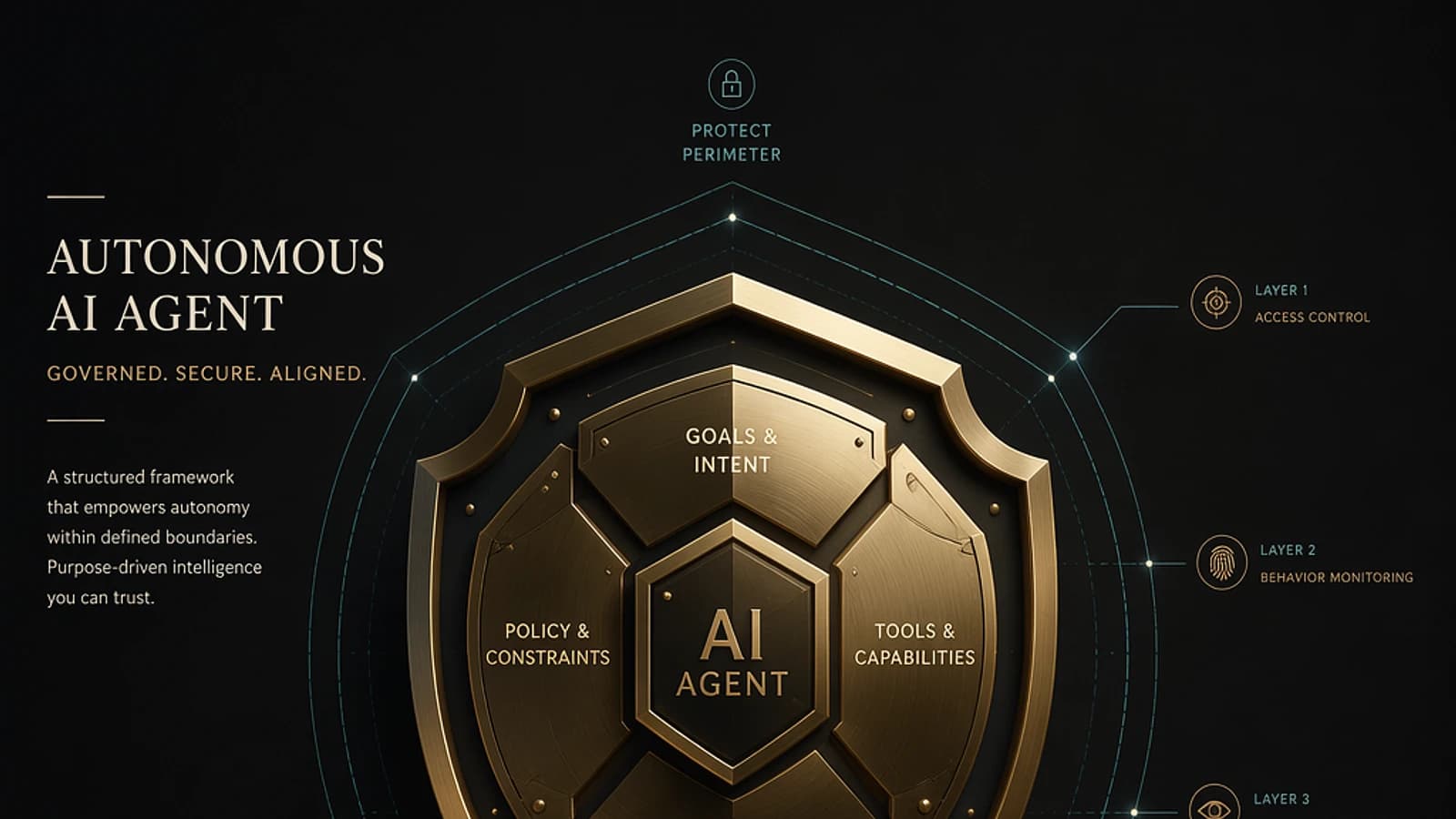
One of the most critical — and often underestimated — aspects of an agentic architecture is identity management. An agent must never execute with the identity of a human user, and multiple agents must not share the same identity.
Agent 365 is the governance framework that addresses these issues:
- Each agent has its own identity in Microsoft Entra ID
- Application of role-based access control (RBAC) to each agent
- Respect for data classifications and sensitivity labels
- Agent registry with synchronization, discovery via endpoints, and SDK integration
- Protection against emerging threats: jailbreaking, prompt injection, hallucinations
Critical Point
If an agent consumes a document classified as "Highly Confidential" to generate new content, the produced artifact must inherit this classification. Failing to follow this rule exposes the organization to data breach risks.
Implementation: Getting Started with Microsoft IQ and Azure AI Foundry
Define the Agent's Intelligence Scope
Identify the knowledge sources needed by your agent: collaborative data (Work IQ), analytical data (Fabric IQ), documentary repositories (Foundry IQ), or web information (Web IQ). Apply the principle of least privilege: give the agent access only to the layers strictly necessary for its mission.
Configure Agent Identity in Microsoft Entra ID
Create a dedicated identity for the agent via the Azure portal or Microsoft Graph API. Assign appropriate RBAC roles on each resource.
1# Creating a Service Principal for an AI agent2$agent = New-AzADServicePrincipal -DisplayName "Agent-ContractReview" -Description "AI Agent for contract review"3 4# Assigning a limited role on a Fabric workspace5New-AzRoleAssignment `6 -ObjectId $agent.Id `7 -RoleDefinitionName "Fabric Viewer" `8 -Scope "/subscriptions/{subscriptionId}/resourceGroups/{rg}/providers/Microsoft.Fabric/workspaces/{workspaceId}"Create a Knowledge Base in Azure AI Foundry (Foundry IQ)
In the Azure AI Foundry portal, create a project and configure a search index pointing to your documentary sources (SharePoint, Blob Storage, specific URLs). Enable hybrid search to combine vector and keyword search.
Connect the Agent to Azure AI Foundry's Model Router
Configure your agent to use the model router rather than a fixed model. Define routing rules based on task complexity.
1from azure.ai.inference import ChatCompletionsClient2from azure.core.credentials import AzureKeyCredential3 4# Connecting to Azure AI Foundry model router5client = ChatCompletionsClient(6 endpoint="https://{your-foundry-endpoint}.services.ai.azure.com/models",7 credential=AzureKeyCredential("{your-api-key}")8)9 10# The router automatically selects the optimal model11response = client.complete(12 model="auto", # Automatic routing13 messages=[14 {"role": "system", "content": "You are an agent specialized in contract analysis."},15 {"role": "user", "content": query}16 ]17)Enable Observability and Continuous Improvement Loop
Enable tracing logs in Azure Monitor to capture each agent interaction. Implement quality metrics (response relevance, latency, cost per request). This data feeds a continuous improvement cycle: prompt adjustment, knowledge base refinement, or even creation of fine-tuned models.
Observability and Continuous Improvement of Agents
Like any production system, an AI agent requires a continuous improvement cycle inspired by DevOps practices:
- Observe: trace all interactions, consulted sources, decisions made
- Analyze: identify cases where response quality is insufficient
- Improve: adjust system prompts, enrich knowledge bases, modify model routing
- Fine-tune: when certain behaviors must be extremely deterministic, consider creating a fine-tuned model that incorporates these behaviors directly in its parameters
This approach applies regardless of where the agent is hosted: Microsoft Azure, hybrid environments, or third-party platforms.
Conclusion: Microsoft IQ as a Trust Foundation for Autonomous Agents
Microsoft IQ represents a major architectural evolution in how organizations equip their AI agents with intelligence. By structuring knowledge access into four complementary layers (Work IQ, Fabric IQ, Foundry IQ, Web IQ), coupled with a robust governance model via Agent 365, it becomes possible to deploy agents truly capable of acting autonomously and reliably.
IT professionals have a central role here: design these architectures with rigor, apply the principle of least privilege, instrument observability, and drive continuous improvement. Trusted autonomous AI is built through architecture, not improvisation.
References and Resources: