The Enterprise IAM Ecosystem in 2026
Modern enterprises operate on average between four and six identity and access management (IAM) platforms, each addressing a specific functional scope. Field reality is unequivocal: according to the latest market data, 61% of data breaches involve compromised credentials, and the global identity market is expected to reach $18 billion by 2026.
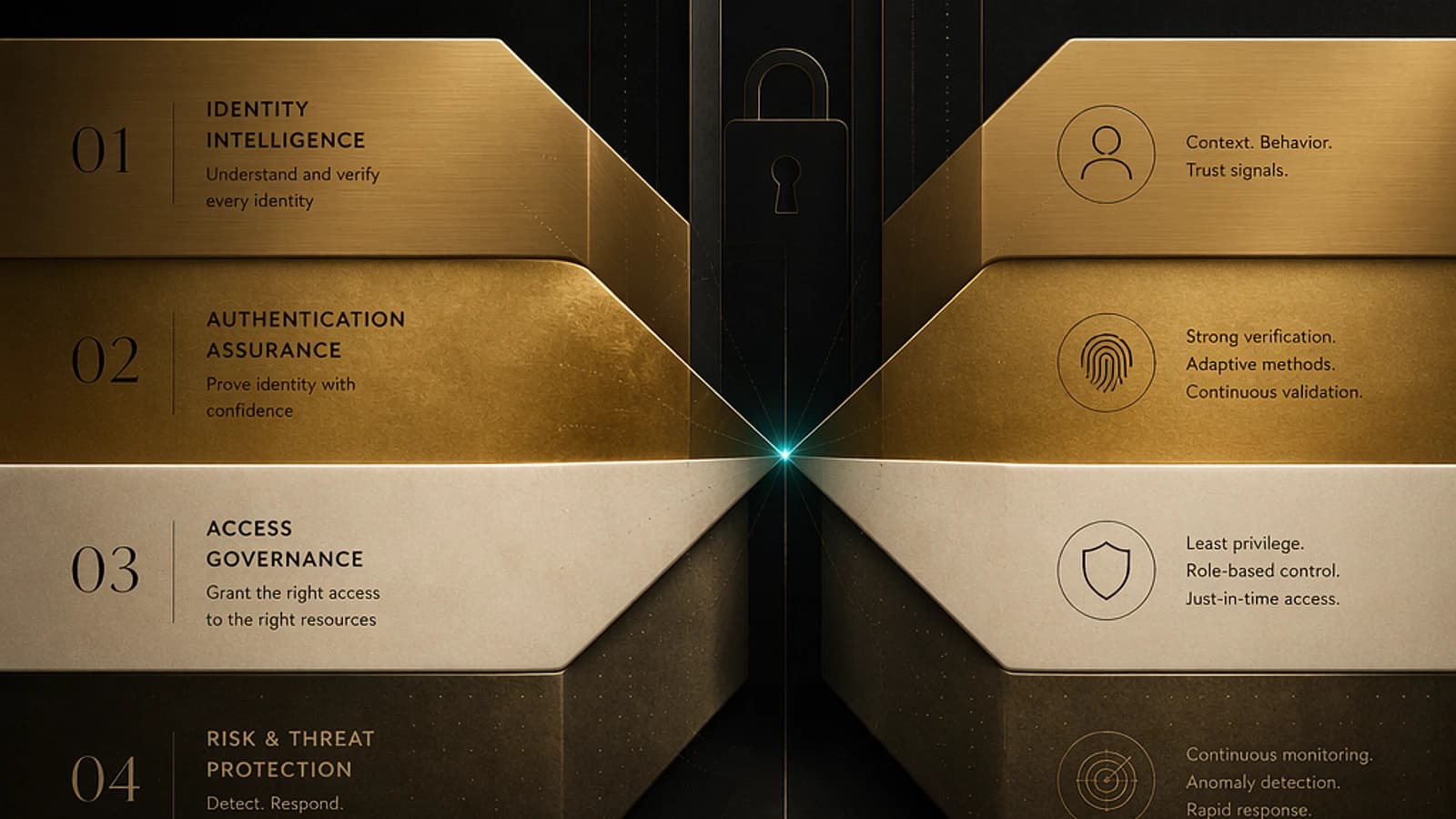
The challenge is no longer choosing an isolated tool, but orchestrating a unified identity fabric — a coherent architecture where each component communicates, strengthens and controls one another. This guide provides a technical deep dive into the four pillars of this ecosystem: Identity Provider (IdP), Identity Governance (IGA), Privileged Access Management (PAM) and Zero Trust.
Key Statistic
Microsoft Research indicates that enabling MFA blocks 99.9% of automated account compromise attacks. It is the security lever with the best effort/impact ratio available today.
The Four Pillars of Identity Fabric
1. Identity Provider (IdP)
The IdP constitutes the entry point for all enterprise access. It authenticates users against directories (Azure AD, LDAP, Active Directory), issues signed tokens and applies access policies. The main solutions on the market include:
- Microsoft Entra ID — native Microsoft, strong hybrid support, integrated Conditional Access
- Okta — leader for cloud-first and SaaS-native organizations
- Ping Identity — excels in complex federation scenarios
- Auth0 (Okta) — developer-oriented, ideal for B2C platforms
- OneLogin — suited for mid-market enterprises
- IBM Security Verify — for enterprise environments with significant legacy systems
2. SSO and Federation
Single Sign-On (SSO) allows a user authenticated once to access all their applications without re-entering credentials. The underlying protocols define interoperability:
- SAML 2.0: dominant XML protocol in the enterprise, supports SP-initiated and IdP-initiated flows
- OIDC (OpenID Connect): identity layer JSON/REST built on top of OAuth 2.0, preferred for mobile apps and SPAs
- OAuth 2.0: delegated authorization framework (code, PKCE, client credentials) — does not handle authentication alone
- SCIM: REST protocol for cross-SaaS provisioning automation
- FIDO2 / WebAuthn: phishing-resistant authentication via public key cryptography
3. Identity Governance & Administration (IGA)
IGA solutions — SailPoint, Saviynt, One Identity, Omada, Microsoft Entra ID Governance — automate the identity lifecycle and ensure regulatory compliance.
4. Privileged Access Management (PAM)
PAM tools — CyberArk, Delinea, HashiCorp Vault, BeyondTrust — secure high-privilege accounts whose compromise would give an attacker total infrastructure access.
How SSO Works: Detailed Authentication Flow
Request Initiation
The user submits credentials or clicks an SSO link from the application (Service Provider). The browser is redirected to the configured Identity Provider.
Identity Validation
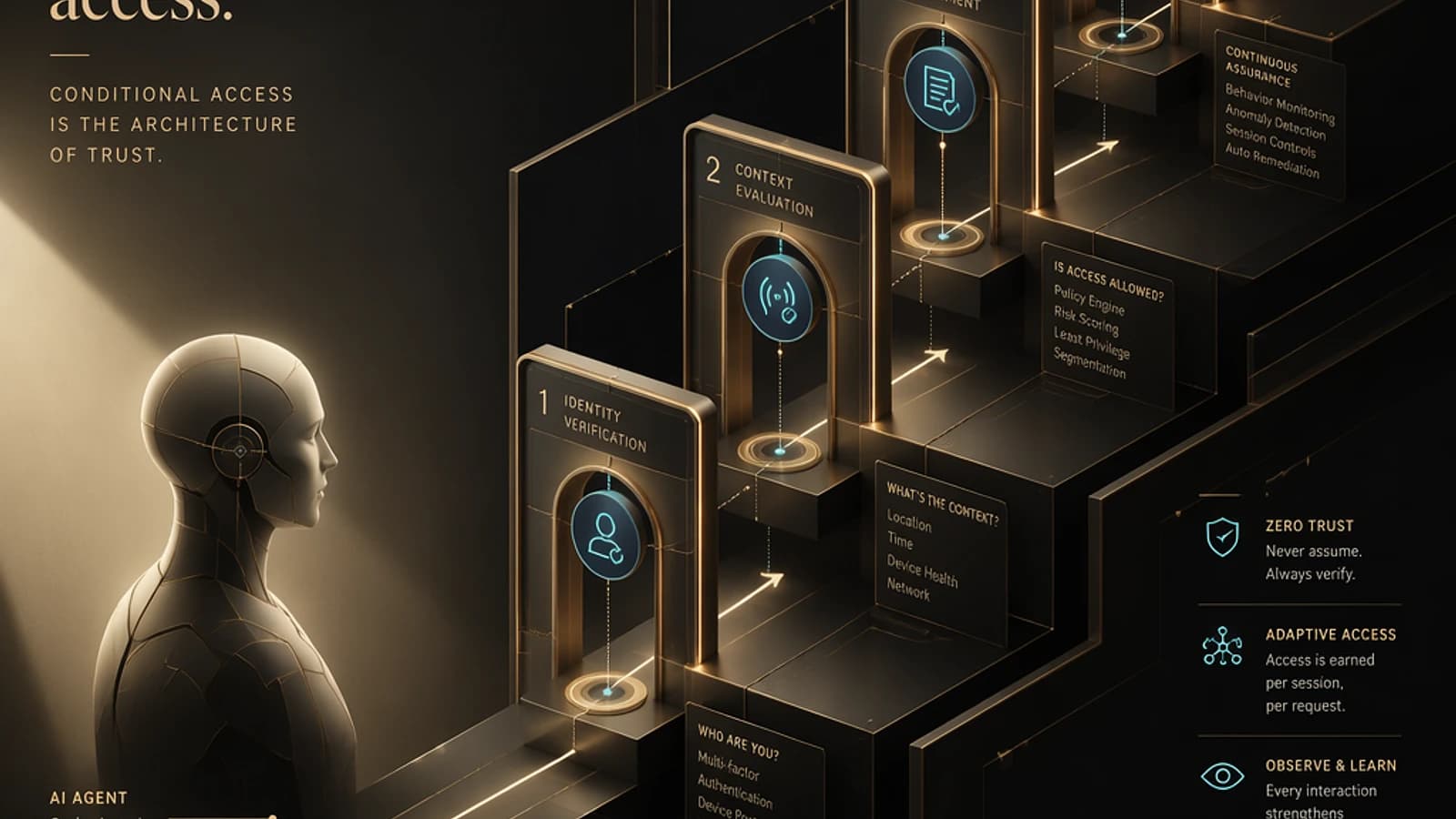
The IdP verifies credentials against the directory (Azure AD, LDAP, Active Directory). If an MFA policy is active, a second factor is required at this stage.
Conditional Access Evaluation
The policy engine evaluates in real-time: MFA status, device compliance, geographic location, user risk score and compliance status. This is the heart of Zero Trust enforcement in Microsoft Entra ID.
Token Issuance
A SAML assertion or JWT (JSON Web Token) is issued to the Service Provider. The token contains signed claims: identity, groups, roles and attributes.
Access Granted
The SP validates the token signature, establishes an application session and grants access without the user re-entering credentials.
Comparison of Main Identity Providers
| Platform | Cloud | On-Premises | MFA | Ideal Use Case |
|---|---|---|---|---|
| Microsoft Entra ID | Excellent | Yes (hybrid) | Excellent | Microsoft / Hybrid Enterprises |
| Okta | Best-in-class | Limited | Excellent | Cloud-first Organizations, SaaS-native |
| Ping Identity | Excellent | Yes | Excellent | Complex Federation, Hybrid Environments |
| Auth0 (Okta) | Best-in-class | No | Excellent | Developer Platforms, B2C Applications |
| OneLogin | Excellent | Yes | Excellent | Mid-market Enterprises |
Access Control: RBAC, ABAC and ReBAC
The granularity of access control is a central concern in modern IAM architectures. Three models coexist, each adapted to different contexts.
RBAC — Role-Based Access Control
The most widespread model: users are assigned to roles, roles obtain permissions on resources. Simple to implement and audit. Its main limitation is the explosion in the number of roles at scale — an enterprise with thousands of roles quickly becomes unmanageable. Recommended for stable organizational structures and highly regulated environments.
ABAC — Attribute-Based Access Control
A policy engine dynamically evaluates three categories of attributes at the moment of each access:
- User attributes: role, clearance level, department
- Resource attributes: classification, owner, location
- Environmental attributes: time, IP range, device posture, MFA status
Policies are expressed in Rego (Open Policy Agent), Cedar (AWS) or XACML. Ideal for Zero Trust architectures and dynamic workforces.
Example of a Rego policy (OPA) for conditional access:
1package iam.access2 3default allow = false4 5allow {6 input.user.department == input.resource.owner_department7 input.user.clearance_level >= input.resource.classification_level8 input.environment.mfa_completed == true9 time.now_ns() >= input.policy.valid_from_ns10 time.now_ns() <= input.policy.valid_until_ns11}ReBAC — Relationship-Based Access Control
Access is determined by relationships between objects rather than static roles. A user has a relationship with a resource: owner, editor, viewer. Hierarchical relationships allow that access to a folder implies access to the documents it contains.
This model is inspired by the Google Zanzibar paper and is implemented in open source by OpenFGA (CNCF sandbox project). It uses (user, relation, object) tuples.
1{2 "tuple_key": {3 "user": "user:alice",4 "relation": "editor",5 "object": "document:budget-2026"6 }7}Which Model to Choose?
Start with RBAC for regulatory compliance. Add ABAC layers for dynamic contextual decisions. Adopt ReBAC for SaaS platforms with complex resource hierarchies (M365, Google Workspace, Notion).
MFA: Ranking by Phishing Resistance
| Method | Phishing Resistance | Use Case |
|---|---|---|
| FIDO2 / Passkeys | Maximum — public key cryptography, credentials tied to domain | Target standard for any organization |
| Certificate-Based Auth | Very High — credentials tied to device | Government, Large Enterprises |
| Push + Number Match | High — resistant if number match enforced | Replacement for traditional push |
| TOTP (Authenticator) | Medium — vulnerable to AiTM phishing | When FIDO2 is unavailable |
| SMS / Email OTP | Low — SIM swapping, email interception | Avoid in sensitive contexts |
Beware of Push Fatigue
MFA fatigue attacks (MFA Fatigue) target users with repeated push notifications. Enable Number Matching and additional context in Microsoft Authenticator to eliminate this attack vector.
Identity Governance (IGA): Closing the Compliance Loop
IGA solutions automate the entire access lifecycle and produce the audit evidence necessary for regulatory compliance.
Lifecycle Management (Joiner-Mover-Leaver)
Integration with HRIS systems (Workday, SAP SuccessFactors) automatically triggers:
- Joiner: access provisioning within minutes of employee arrival
- Mover: rights adjustment during a job change or department transfer
- Leaver: immediate revocation of all access upon contract termination
Access Reviews and Attestation
Managers and data owners periodically attest to their teams' authorizations. Uncertified access is automatically tracked, flagged and revoked according to defined policy.
Segregation of Duties (SoD)
Detection of authorization conflicts between systems (SAP, Oracle, Salesforce). Custom rules can be defined for business applications. SoD is a key requirement of SOX Section 404.
Automated Regulatory Compliance
- SOX (Section 404) — financial access controls
- GDPR — personal data access rights
- HIPAA — health data access
- PCI-DSS (Requirement 7) — cardholder data access restriction
- ISO 27001 (Annex A.9) — logical access control
PAM: Securing High-Privilege Accounts
Privileged accounts — domain admins, database owners, cloud root, CI/CD secrets — are the priority target of any attacker. A well-configured PAM eliminates shared static credentials and drastically limits the blast radius of a compromise.
Key Components of a PAM Architecture
- Credential Vault: encrypted storage with automatic rotation and check-in/check-out approval workflow
- Just-in-Time (JIT) Access: temporary elevation tied to a ticket (ServiceNow, Jira), automatic revocation upon expiration
- Session Recording: complete video capture of privileged sessions with real-time anomaly detection
- Secrets Management: API keys, DB credentials, TLS certificates managed centrally with dynamic secret generation
- Endpoint Privilege Management: removal of local admin rights, controlled elevation by policy
Comparison of Leading PAM Solutions
| Solution | Strength | DevOps Secrets | Endpoint | Positioning |
|---|---|---|---|---|
| CyberArk | Digital Vault AES-256, split-key architecture | Conjur (DevOps) | Endpoint Privilege Manager | Enterprise Leader, Maximum Coverage |
| HashiCorp Vault | Dynamic Secrets, cloud-native, open core | Native (AWS/Azure/GCP engines) | No native | Developer-first, Kubernetes/Terraform |
| Delinea | Secret Server + Privilege Manager unified | Cloud Suite | Privilege Manager | Thycotic+Centrify, Mid-to-Large Enterprise |
| BeyondTrust | Password Safe + Remote Access integrated | Application Control | Windows/Mac/Linux | Unified PAM Platform, Broad Coverage |
Example Vault secrets engine configuration for a PostgreSQL database:
1# Enable the database secrets engine2vault secrets enable database3 4# Configure PostgreSQL connection5vault write database/config/my-postgresql-database \6 plugin_name=postgresql-database-plugin \7 allowed_roles="readonly" \8 connection_url="postgresql://{{username}}:{{password}}@postgres:5432/mydb" \9 username="vault-admin" \10 password="vault-admin-password"11 12# Create a role with automatic rotation13vault write database/roles/readonly \14 db_name=my-postgresql-database \15 creation_statements="CREATE ROLE \"{{name}}\" WITH LOGIN PASSWORD '{{password}}' VALID UNTIL '{{expiration}}'; GRANT SELECT ON ALL TABLES IN SCHEMA public TO \"{{name}}\";" \16 default_ttl="1h" \17 max_ttl="24h"Static Credentials: Critical Risk
Shared and static credentials (admin passwords never changed, distributed SSH keys) are the first vector for lateral movement after initial compromise. Eliminating these credentials must be the absolute priority of any PAM program.
Zero Trust Architecture: The Five Pillars
Zero Trust is not a product but an architectural model founded on three principles: Never trust, Always verify, Assume breach. Every access must be authenticated, authorized and encrypted, regardless of its network origin.
Pillar 1 — Identity
Systematic strong authentication: MFA, passwordless, Risk-based Conditional Access. Microsoft Entra ID Protection ensures real-time risk detection. Every identity must be verified at each access point. Elimination of permanent standing access.
Pillar 2 — Device
Only healthy and compliant endpoints access corporate resources. Management via Microsoft Intune or Jamf. Health attestation services verify OS version, patch level, encryption and endpoint security solutions.
Pillar 3 — Network
Micro-segmentation eliminates implicit trust based on network location. A Software-Defined Perimeter controls east-west traffic. The assume breach principle limits blast radius: no resource is inherently trusted because it is in the corporate network.
Pillar 4 — Application
Authorization per-call enforced at API gateways. Short-lived tokens. No implicit trust between microservices. Open Policy Agent (OPA) for policy enforcement at infrastructure level.
Pillar 5 — Data
Sensitivity classification and labeling across all repositories. DLP policies at endpoint, network and cloud levels. Encryption at rest and in transit. Microsoft Purview sensitivity labels to protect data wherever it goes.
Roadmap: Building Your Unified Identity Fabric
Deploy a Robust IdP
Start with Microsoft Entra ID (for Microsoft/hybrid environments) or Okta (for cloud-first organizations). Enable Conditional Access and enforce MFA for all users. Migrate applications to OIDC/SAML.
Add the IGA Layer
Integrate an IGA solution (SailPoint, Saviynt or Microsoft Entra ID Governance) with your HRIS. Automate Joiner-Mover-Leaver. Implement first access reviews for sensitive access.
Secure Privileged Access with PAM
Deploy a credential vault (CyberArk, Delinea or HashiCorp Vault). Eliminate shared static credentials. Enable JIT access for admin accounts. Enable session recording on critical access.
Layer On Zero Trust
Enable Microsoft Entra ID Protection for risk detection. Deploy granular Conditional Access policies. Integrate device compliance via Intune. Implement OPA for application authorization. Migrate to FIDO2/Passkeys for sensitive accounts.
Essential Standards and References
Every IAM architect must master the following standards:
- SAML 2.0 — OASIS, dominant enterprise SSO protocol
- OIDC — OpenID Foundation, identity layer on OAuth 2.0
- OAuth 2.0 — RFC 6749, delegated authorization framework
- SCIM 2.0 — RFC 7644, automated provisioning protocol
- FIDO2 / WebAuthn — W3C, phishing-resistant authentication
- NIST SP 800-63B — Guidelines on Digital Identity Authentication
- Google Zanzibar — Foundational ReBAC Paper
- OpenFGA — Open source ReBAC implementation (CNCF)
- Open Policy Agent — Cloud-native ABAC Policy Engine
Integration is the Real Challenge
The value of an IAM fabric lies not in individual tools but in their integration. APIs, SCIM and Just-in-Time provisioning constitute the connective tissue of the architecture. This is where 70% of engineering effort is concentrated — plan accordingly.
Conclusion
Enterprise IAM in 2026 is not a question of choosing a single tool, but of coherently orchestrating an identity fabric. The recommended sequence remains constant: Solid IdP → IGA for governance → PAM for privileges → Zero Trust as the envelope layer.
The 61% of breaches involving compromised credentials is not inevitable — it is the direct result of incomplete or poorly integrated IAM architectures. A well-architected identity fabric, built on open standards (SAML, OIDC, SCIM, FIDO2) and Zero Trust principles, drastically reduces this attack surface.