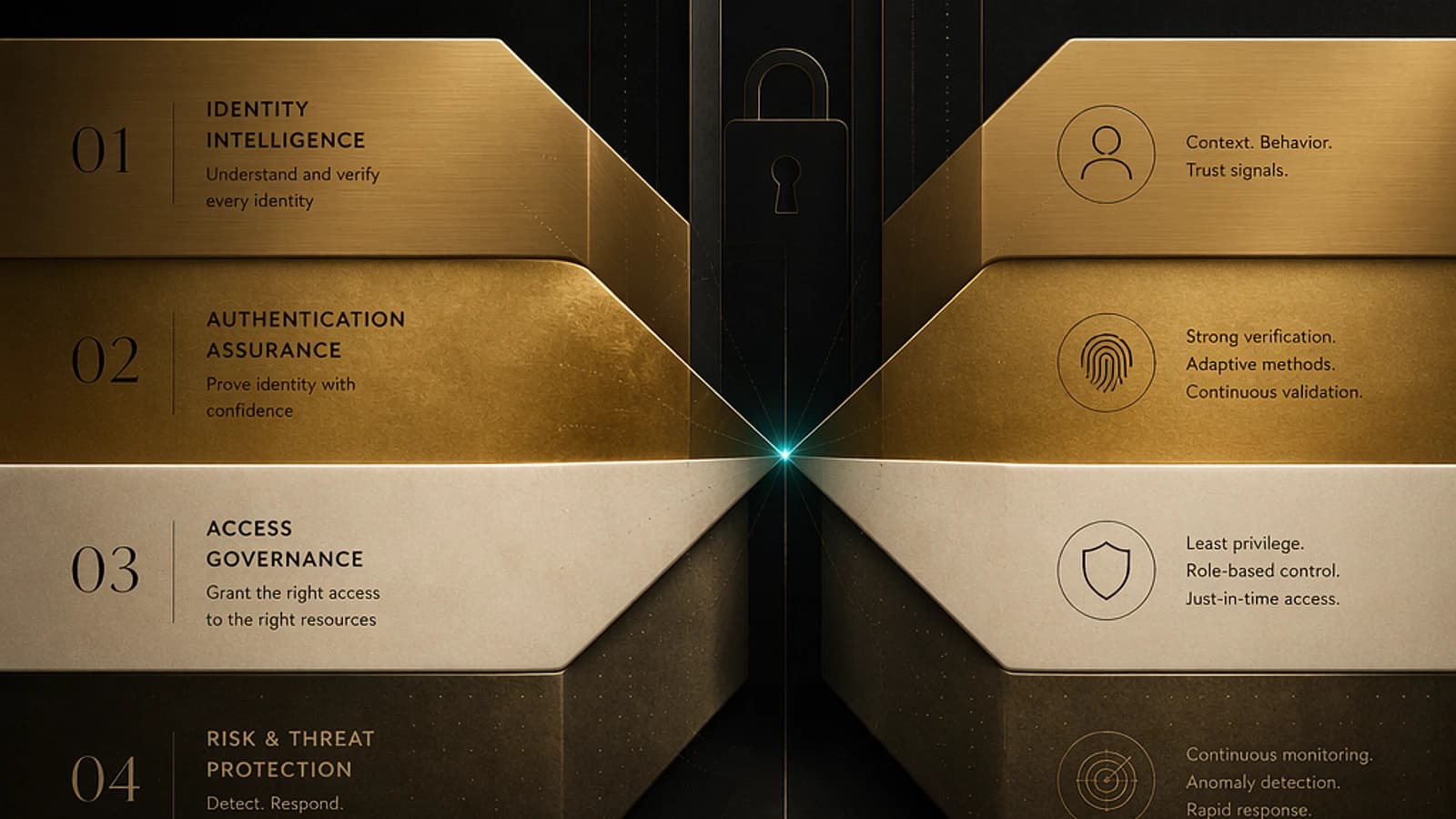
Introduction: four complementary layers, not competing tools
A clear observation emerges regularly during security audits: organizations deploy identity solutions in silos, without a comprehensive architectural vision. Yet IAM, PAM, IGA, and CIEM are not competing products — they are four distinct functional layers of the same coherent architecture, commonly referred to as the Identity Fabric.
Each layer addresses a specific question and covers a distinct scope within the identity and access lifecycle. In isolation, they create blind spots. Integrated, they form a robust defense mesh, particularly suited to Microsoft 365 and Azure environments, where Microsoft Entra ID plays a transversal role across multiple layers.
Definition: Identity Fabric
Identity Fabric designates a unified identity management architecture that integrates all IAM, PAM, IGA, and CIEM layers within a coherent continuum, rather than a collection of disparate tools. This concept is at the heart of the Zero Trust strategy.
IAM: the foundation of authentication and authorization
Functional scope
Identity and Access Management (IAM) constitutes the first layer of the Identity Fabric. It answers the fundamental question: Who are you, and what can you do?
Its functions cover:
- Authentication (AuthN): identity verification via password, MFA, certificates, FIDO2
- Authorization (AuthZ): permission control based on roles or attributes (RBAC/ABAC)
- Single Sign-On (SSO): unified access to multiple applications from a single authentication
- Multi-Factor Authentication (MFA): second factor required to reduce attack surface
- Basic lifecycle management: provisioning and deprovisioning of employee identities
Representative solutions
Major players in this segment include Microsoft Entra ID, Okta, Ping Identity, and ForgeRock. In the Microsoft ecosystem, Entra ID is the cornerstone of any Identity Fabric architecture, serving as the identity provider (IdP) for all M365 and Azure services.
Microsoft Tip
In a Microsoft 365 tenant, enable Entra ID conditional access policies to strengthen IAM beyond simple authentication. Combine them with Entra ID Protection for real-time risk detection.
PAM: protecting high-privilege access
Functional scope
Privileged Access Management (PAM) constitutes the second layer. It addresses a distinct problem: How do you protect critical assets (Tier-0) and corporate secrets?
PAM is often described as the vault of the Identity Fabric. Its capabilities include:
- Password Vaulting: encrypted storage and automatic rotation of secrets and passwords for privileged accounts
- Session Recording: recording and playback of administrator sessions for audit and forensic purposes
- Just-In-Time Access (JIT): temporary, on-demand privilege elevation, limiting permanent exposure
- Secrets Management: centralized management of API keys, certificates, and tokens used by applications
- Least Privilege Enforcement: systematic application of the principle of least privilege
Why PAM is under-integrated
In the majority of organizations, PAM remains the least mature layer. Yet this is where defense against ransomware and post-compromise lateral movement is played out. An attacker who obtains standard credentials without PAM access remains confined to a limited perimeter; an attacker who compromises an unvaulted administrator account can reach the entire infrastructure.
Reference solutions include CyberArk, BeyondTrust, Delinea, and HashiCorp Vault. On the Microsoft side, Entra Privileged Identity Management (PIM) offers native JIT capabilities for Azure AD and Azure RBAC roles.
1# Example: activate an eligible role via Microsoft Graph (Entra PIM)2# Prerequisites: Microsoft.Graph module installed and authenticated3 4$body = @{5 action = "selfActivate"6 principalId = "<user-object-id>"7 roleDefinitionId = "<role-definition-id>"8 directoryScopeId = "/"9 justification = "Scheduled maintenance - ticket #INC-0042"10 scheduleInfo = @{11 startDateTime = (Get-Date).ToUniversalTime().ToString("o")12 expiration = @{13 type = "AfterDuration"14 duration = "PT2H"15 }16 }17}18 19Invoke-MgGraphRequest -Method POST `20 -Uri "https://graph.microsoft.com/v1.0/roleManagement/directory/roleAssignmentScheduleRequests" `21 -Body ($body | ConvertTo-Json -Depth 5)Attention: break-glass accounts
Any organization using Entra PIM must maintain at least two emergency access accounts (break-glass) excluded from conditional access policies and stored outside the main PAM vault.
IGA: access governance and compliance
Functional scope
Identity Governance and Administration (IGA) is the third layer. Its guiding question: Should this user still have this access, and can you demonstrate it to auditors?
IGA intervenes where IAM stops. It is not merely about verifying identity — it governs the relevance of rights over time:
- Joiner-Mover-Leaver (JML) Lifecycle: automation of provisioning, role changes, and access revocation
- Access Certification Campaigns: periodic campaigns to recertify rights by business owners
- Separation of Duties (SoD): detection and prevention of conflicting role combinations
- Role Mining and Role Engineering: analysis of actual rights to build coherent, auditable roles
- Audit Trail: complete traceability of access decisions to meet regulatory requirements (ISO 27001, SOC2, NIS2)
IGA in the Microsoft ecosystem
Microsoft Entra ID Governance natively integrates IGA functionality directly into the Entra platform: Access Reviews, Entitlement Management, and Lifecycle Workflows. This IAM+IGA convergence within the same platform represents a significant architectural advantage for Microsoft-centric organizations.
Specialized solutions include SailPoint, Saviynt, and Oracle Identity Governance.
CIEM: visibility into cloud and machine entitlements
Functional scope
Cloud Infrastructure Entitlement Management (CIEM) is the fourth layer, the newest and often the least covered. Its question: Who has access to what in the cloud — whether human or machine?
CIEM addresses a reality unique to cloud environments: non-human identities (service accounts, managed identities, workload identities, AI agents) proliferate far beyond human identities, creating an invisible attack surface for traditional IAM and IGA tools.
Its key capabilities:
- Entitlement Discovery: exhaustive mapping of all effective rights in multi-cloud environments (Azure, AWS, GCP)
- Permission Right-Sizing: identification of excessive rights and recommendations for reducing to least privilege
- Workload Identity Management: governance of identities assigned to VMs, containers, serverless functions, and CI/CD pipelines
- Non-Human Identity (NHI) Governance: control of service principals, managed identities, and API tokens
- CIEM + CSPM Integration: correlation between cloud rights and infrastructure security posture
Growing importance in the age of AI
With the proliferation of AI agents and automated workloads, non-human identities now represent the majority of active identities in an Azure tenant. CIEM thus becomes the critical layer for governing these entities. Leading players include Wiz CIEM, Sonrai Security, Ermetic (acquired by Tenable), and Saviynt.
Risk: over-provisioning of Managed Identities
In Azure, Managed Identities are often created with overly broad roles (Contributor at subscription level) for simplicity. Regular CIEM audits are essential to detect these deviations before they are exploited. Use Azure RBAC Analyzer and Microsoft Defender for Cloud recommendations.
Comparative architecture: the four layers at a glance
| Layer | Key Question | Main Functions | Microsoft Solutions |
|---|---|---|---|
| IAM | Who are you and what can you do? | AuthN, AuthZ, SSO, MFA | Microsoft Entra ID |
| PAM | How do you protect critical access? | Vaulting, JIT, Session Recording, Secrets | Entra PIM, Azure Key Vault |
| IGA | Is this access still justified? | JML Lifecycle, Certification, SoD, Audit | Entra ID Governance |
| CIEM | Who accesses what in the cloud? | Entitlement Discovery, NHI, Right-Sizing | Defender for Cloud (CSPM) |
How the four layers articulate within a Zero Trust model
The interdependence of layers is at the heart of the Zero Trust model. Each layer feeds the others according to a logic of continuity:
- IAM authenticates and establishes identity → it feeds IGA which governs its rights
- IGA certifies the legitimacy of access → it informs PAM which accounts deserve to be elevated
- PAM protects critical access → it reduces blast radius in case of IAM compromise
- CIEM extends visibility to the cloud → it complements IGA for machine identities outside HR scope
This articulation can be schematized as follows:
1[IAM] ──Verified Identity──► [IGA] ──Certified Rights──► [PAM] ──Protected Access──► Tier-0 Resource2 │3 ▼4 [CIEM] ──► Cloud & Machine IdentitiesArchitecture Tip
For Microsoft organizations, start by consolidating IAM and IGA on Entra ID + Entra ID Governance, then integrate Entra PIM for PAM. CIEM can then be addressed via Microsoft Defender for Cloud combined with a specialized third-party solution for multi-cloud environments.
Roadmap: building your Identity Fabric progressively
Consolidate the IAM foundation
Audit your current identity provider. For Microsoft environments, ensure Entra ID is configured with mandatory MFA, conditional access policies active, and hybrid synchronization (Entra Connect Sync or Cloud Sync) operational.
Deploy PAM on Tier-0 accounts
Inventory all privileged accounts (domain administrators, Global Admins, Azure owners). Enable Entra PIM for Entra ID and Azure RBAC roles. Integrate a secrets vault (Azure Key Vault or third-party solution) for application credentials.
1# List all active Global Admins (permanent) in Entra ID2Get-MgDirectoryRoleMember -DirectoryRoleId (Get-MgDirectoryRole | Where-Object { $_.DisplayName -eq "Global Administrator" }).Id | Select-Object Id, DisplayName, UserPrincipalNameImplement IGA for access governance
Enable Access Reviews in Entra ID Governance for groups with sensitive access. Configure Lifecycle Workflows to automate the Joiner-Mover-Leaver process. Define Access Packages for temporary or project-based access.
Extend visibility with CIEM
Enable Microsoft Defender for Cloud (CSPM Defender plan) to gain visibility into excessive permissions on your Azure subscriptions. For multi-cloud context, evaluate a dedicated CIEM solution. Audit Managed Identities and Service Principals regularly.
1# List all Managed Identities and their Azure RBAC roles2Get-AzADServicePrincipal | Where-Object { $_.ServicePrincipalType -eq "ManagedIdentity" } | ForEach-Object {3 $sp = $_4 $roles = Get-AzRoleAssignment -ObjectId $sp.Id5 [PSCustomObject]@{6 Name = $sp.DisplayName7 ObjectId = $sp.Id8 Roles = ($roles.RoleDefinitionName -join ", ")9 Scopes = ($roles.Scope -join ", ")10 }11}Conclusion: think mesh, not tool catalog
Adopting an Identity Fabric posture is not about successive acquisition of four products. It requires an architectural vision where each layer is deployed with awareness of the others, with bidirectional information flows and centralized governance.
In a Zero Trust context, real value emerges from orchestration:
- An identity verified at entry (IAM)
- Privileged access controlled and temporary (PAM)
- Governance auditable and certifiable (IGA)
- Visibility exhaustive on cloud and machines (CIEM)
For organizations engaged in the Microsoft ecosystem, the convergence of Entra ID + Entra ID Governance + Entra PIM + Defender for Cloud provides native coverage of all four layers, reducing integration complexity while maintaining openness to specialized third-party solutions.
Construct your Identity Fabric as a unified system — not as a collection of tools.