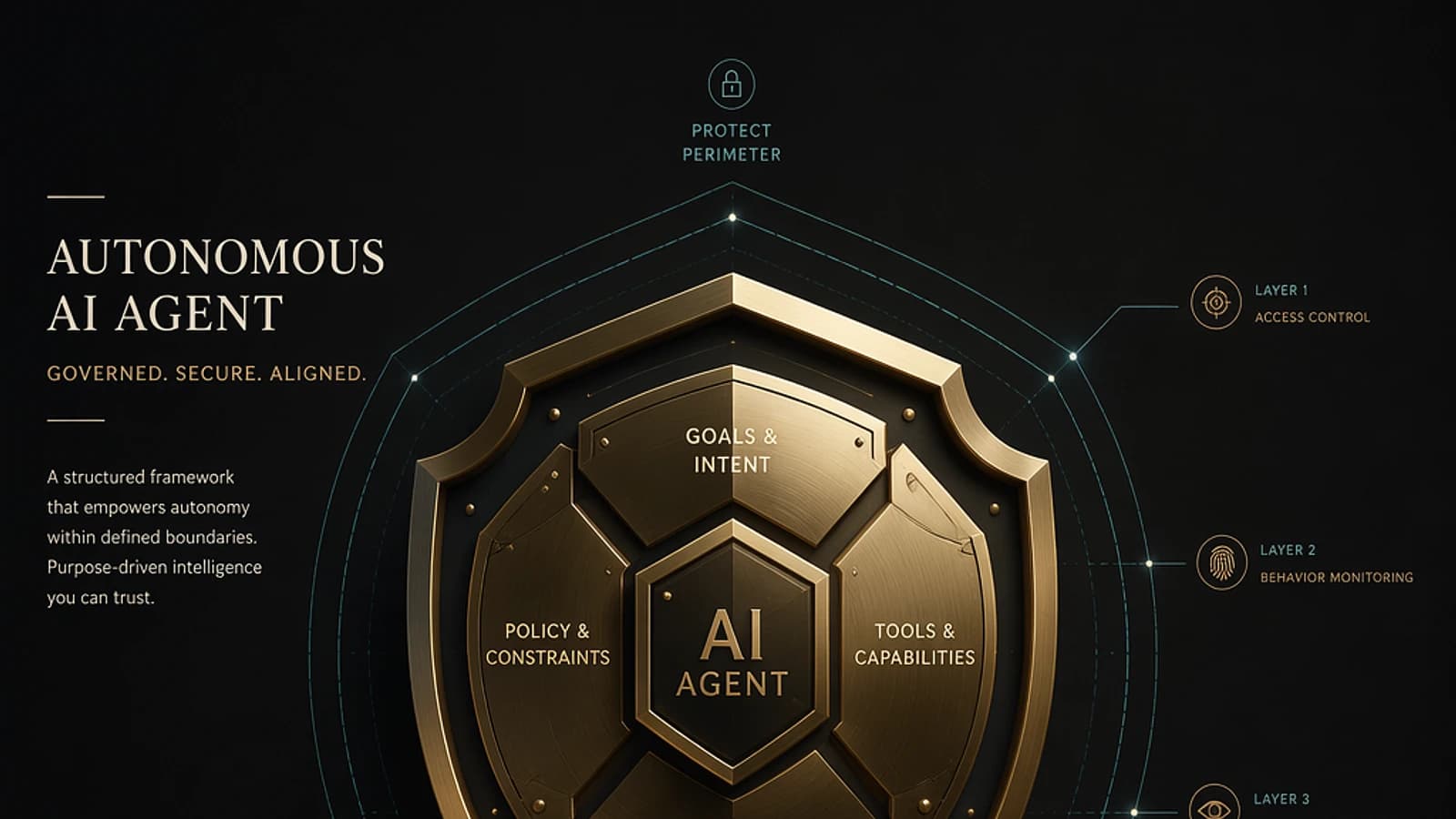
Why AI Agents Are Not Just Simple Chatbots
For the past few years, the word "AI" has often been associated with conversational assistants — interfaces that answer your questions in natural language. But a new generation of systems is changing the game in professional environments: AI agents (or AI agents). Before going further, let's establish a clear definition.
An AI agent is an autonomous system capable of perceiving its environment, reasoning about objectives and taking actions to achieve results, leveraging tools and data.
In the Microsoft ecosystem, this reality is materialized with platforms like Copilot Studio, Azure AI Foundry or Azure AI Agent Service. Understanding what an AI agent is — and why it raises specific security questions — has become a key skill for IT teams and cloud architects.
Essential Vocabulary
The term autonomy refers here to the system's ability to chain together decision-making and action steps without human intervention between each step. It's not intelligence in the human sense: it's goal-guided orchestration.
Chatbot vs AI Agent: A Fundamental Distinction
To grasp the issue, let's start with the most telling comparison. Imagine a chatbot as an automated information booth: you ask a question, it answers, and the transaction ends there. An AI agent, on the other hand, resembles an assistant who receives a mission, goes off to find the necessary information, makes intermediate decisions and comes back to you with a result — without you having to detail each step.
| Criterion | Chatbot | AI Agent |
|---|---|---|
| Mode of operation | Responds to a single prompt | Pursues a defined objective |
| Real actions | None (informational only) | Executes actions on systems |
| Memory | Limited, often none between sessions | Exploits persistent context |
| Interactions | One exchange at a time | Orchestrates multi-step workflows |
| Connections | Generally isolated | Connected to APIs, tools and data sources |
This increase in autonomy corresponds exactly to what Microsoft materializes with Copilot agents capable of calling connectors, third-party APIs and structured data sources through orchestrated flows.
Memory Aid
Remember the formula: chatbot = respond, AI agent = accomplish. The distinction is simple, but its technical and security implications are considerable.
The Observe–Reason–Plan–Act–Learn Cycle
The operation of an AI agent is structured around an iterative loop in five phases. Understanding each one makes it possible to identify where to intervene — whether for optimization or security.
Observe — Perceiving the Environment
The agent collects information from its environment: user messages, data from connected systems, API results, event logs. This is the entry point for all future decisions.
In Azure AI Agent Service, this phase corresponds to ingesting messages into a thread (persistent conversation thread).
Reason — Analyze and Understand
The agent interprets the information received, identifies the underlying intent and evaluates available actions. This is where the language model (LLM, Large Language Model) comes into play to reason about the context.
Plan — Develop a Strategy
The agent builds an action plan to achieve its objective. In complex architectures, this step may involve an orchestrator — a component that breaks down a task into subtasks assigned to different specialized agents.
Act — Execute Actions
The agent calls tools, APIs or systems to implement the decisions made. In Copilot Studio, this corresponds to invoking Power Platform connectors or custom HTTP plugins.
Minimal example of tool invocation with the Azure AI Projects SDK (Python):
1from azure.ai.projects import AIProjectClient2from azure.identity import DefaultAzureCredential3 4client = AIProjectClient.from_connection_string(5 credential=DefaultAzureCredential(),6 conn_str="<your_connection_string>"7)8 9# Creating an agent with a Bing search tool10agent = client.agents.create_agent(11 model="gpt-4o",12 name="agent-demo",13 instructions="You are an assistant that searches for information and summarizes results.",14 tools=[{"type": "bing_grounding"}]15)16print(f"Agent created: {agent.id}")Learn — Learn and Iterate
The agent draws lessons from the results obtained to refine its future decisions. This phase closes the loop and returns to observation, making the cycle continuous. In production architectures, this mechanism can rely on persistent memory or fine-tuning mechanisms.
The Analogy and Its Limits
You can compare this cycle to how a project manager works: they observe the situation, analyze the constraints, plan tasks, delegate execution and adjust their plan based on feedback. The fundamental difference: the agent operates in milliseconds, without moral judgment or awareness of organizational context. This is precisely where human governance remains essential.
Why Security Becomes an Absolute Priority
The autonomy of AI agents opens up remarkable automation prospects — but it also significantly widens the attack surface. Several risks deserve special attention.
Threat Vectors Specific to Agents
- Access to sensitive data: an agent connected to SharePoint, Exchange or a business database can read, modify or exfiltrate information if its permissions are not properly defined.
- Prompt injection: an attack technique consisting of inserting malicious instructions into data that the agent processes (an email, a document, a web page) to hijack its behavior. Learn more about OWASP LLM Top 10.
- Privilege escalation: if the agent has excessive rights, an attacker who manages to manipulate it indirectly obtains these rights.
- Irreversible actions: unlike a chatbot that merely answers, an agent can send emails, modify files or trigger workflows — actions that are difficult or impossible to undo.
Critical Risk: Prompt Injection
Prompt injection is today one of the most documented threats to LLM agents. A malicious document processed by your agent can give it hidden instructions. Systematically apply the principle of least privilege and log all agent actions.
Security Best Practices in the Microsoft Ecosystem
- Principle of least privilege: limit the permissions of each agent to the strict minimum via Microsoft Entra ID and application roles.
- Governance with Microsoft Purview: enable data protection policies to monitor what the agent reads and manipulates. See the Purview documentation on AI governance.
- Logging and detection: integrate agent action logs into Microsoft Sentinel to detect unusual behavior.
- Human validation on critical actions: in Copilot Studio, configure confirmation steps (confirmation prompts) before any destructive or irreversible action.
- Zero Trust: never implicitly trust an agent, even an internal one. Verify each API call, each data access. Microsoft Zero Trust Framework.
Attention to Connector Permissions
In Copilot Studio and Power Automate, connectors often inherit the permissions of the user who configures them. An agent deployed in production should use a dedicated service account with minimal rights, not an administrator's account.
Identifying Control Points in the Think–Act Cycle
Once the Observe–Reason–Plan–Act–Learn cycle is understood, it becomes possible to place security controls at each step.
- Observe → Filter and validate incoming data. Don't let the agent ingest untrusted content without prior validation.
- Reason → Define clear and restrictive system instructions (system prompts) to limit the scope of reasoning.
- Plan → Enforce safeguards on types of authorized actions (tool allowlist).
- Act → Log each tool call and configure alerts on sensitive actions.
- Learn → Regularly audit the agent's persistent memory to detect any injected data.
Key Takeaways
AI agents represent a qualitative leap forward from traditional chatbots: they no longer merely respond, they act. This ability to orchestrate autonomous workflows, call tools and adapt in real time opens considerable prospects for business automation — particularly in the Microsoft 365 and Azure ecosystem.
But this autonomy has a price: each degree of freedom granted to an agent is a potential attack surface. Mastering the Observe–Reason–Plan–Act–Learn cycle not only enables better design of these systems, but also tells you precisely where and how to apply security controls.
The golden rule remains simple: the more autonomous an agent is, the more rigorous its governance must be.