Introduction
In a constantly evolving security context, traditional VPN models show their limitations against modern threats. Microsoft Entra Global Secure Access introduces an advanced approach based on SSE (Secure Service Edge) and ZTNA (Zero Trust Network Access) to redefine remote access and integrate robust identity controls.
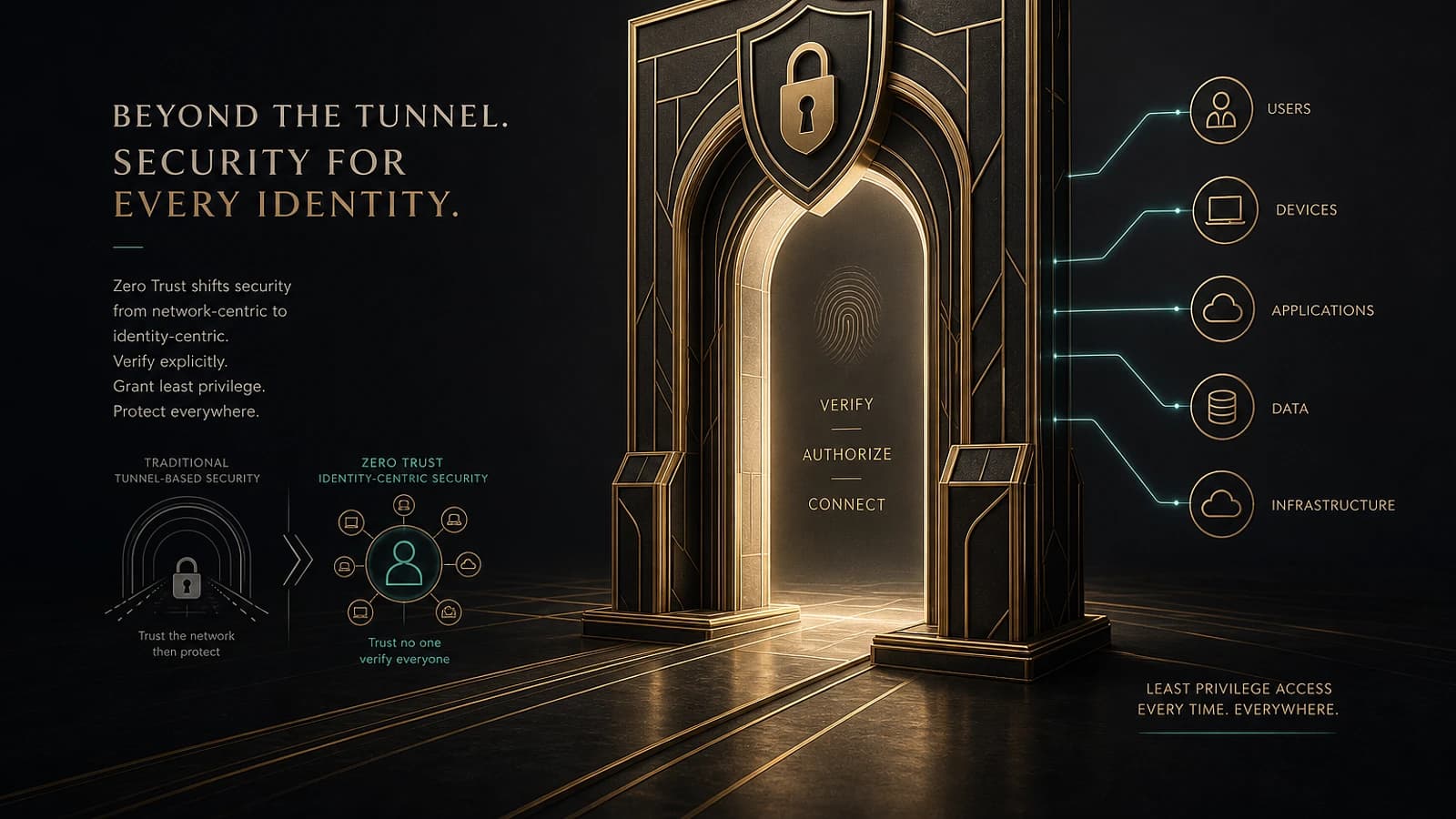
[IMAGE:0:url:SSE vs VPN Schema]
With emphasis on identities and session contexts, Entra Global Secure Access becomes the new "entry point" for Zero Trust. This article explores recent changes, deployment best practices, and practical benefits for IAM and SecOps teams.
Recent Evolution and Friction Points of Classic VPNs
What's the change?
VPN approaches attempt to control network access primarily through encrypted tunnels. However:
- Lack of granular identity: VPNs don't consider user identities or session contexts.
- Increased attack surface: Threats like credential theft or MITM attacks are amplified.
- Operational complexity: Managing multi-site configurations via VPN becomes a logistical nightmare.
In comparison, Microsoft recently introduced major evolution points in its SSE/ZTNA solutions:
- GA Support for Entra Internet Access and Private Access: Simplified access and enriched Zero Trust conditions.
- Integration with Conditional Access identity policy: Real-time risk enforcement.
- Maturity of logs and traffic shaping: Increased visibility into flows and critical events.
Good to know
SSE solutions like Entra offer globally distributed PoPs, ensuring performant and secure connections.
Capability Table: Status and Prerequisites
| Feature | Status (GA/Preview) | Prerequisites | Impact | Sources |
|---|---|---|---|---|
| Entra Internet Access | General Availability | Premium P2 License | Reduces Internet exposure | Microsoft Documentation |
| Private Access | Preview | Conditional Access Configuration | Optimization of local access flows | Tech Community |
Myths vs Reality: Decoding
Myth 1: "SSE completely replaces VPN."
Reality: SSE reduces VPN dependencies but may require coexistence depending on legacy scenarios.
Myth 2: "Zero Trust eliminates all risks."
Reality: Zero Trust greatly reduces the impact of attacks, but remains fallible against compromised devices.
Myth 3: "SSE/ZTNA deployment is simple."
Reality: It requires clear understanding of dependencies (Conditional Access policy, licensing).
Myth 4: "User impact is invisible."
Reality: Some authentication or access flows may require UX adjustments.
Myth 5: "All sessions are protected by SSE/ZTNA without exception."
Reality: Practical exclusions (incompatible legacy sites and apps) may exist.
30/60/90 Day Action Plan
30 days: Pilot
Start by deploying Entra Internet Access on a test group, with strict Conditional Access policies.
1# Command to enable Internet Access2Enable-MsolService -ServiceName "InternetAccess"60 days: Expansion
Extend the configuration to critical departmental teams, adding exclusions based on legacy requirements.
90 days: Standardization
Apply configurations to all internal operations, with audit implementation.
Useful Links
- Microsoft Entra documentation
- Tech Community articles on Zero Trust
- Microsoft 365 Licensing Buying Guide
Glossary
- SSE (Secure Service Edge): Architecture that integrates zero trust functions for secure access.
- ZTNA (Zero Trust Network Access): Security paradigm based on constant verification of identity and risk.
- Conditional Access: Authentication and authorization mechanism based on risk contexts.
- PoP (Point of Presence): A traffic hub for global network flow management.
Conclusion
The Zero Trust transformation for 2026 requires a pragmatic approach to SSE/ZTNA with Microsoft Entra Global Secure Access. By moving away from VPN models, administrators can benefit from enhanced security adapted to the modern cloud.